A busy real estate agency can receive hundreds of inquiries a week from its website, property portals, WhatsApp, and social ads. Most are vague: "Is this still available?" or "Send me details." Agents spend hours replying to people who will never buy, while serious buyers wait and go to a competitor. An AI lead qualification assistant fixes that by reading every inquiry instantly, asking the right follow-up questions, and routing hot leads to a human agent within minutes.
What Lead Qualification Means in Real Estate
Qualification is about answering a few questions early: what the person wants (buy, rent, sell, or invest), their budget, preferred areas, property type, timeline, financing status, and how they want to be contacted. Traditionally an agent or call-center team collects this by phone. An AI assistant collects the same facts through natural conversation, stores them as structured data in your CRM, and scores the lead so your team focuses on the right people first.
The Architecture at a Glance
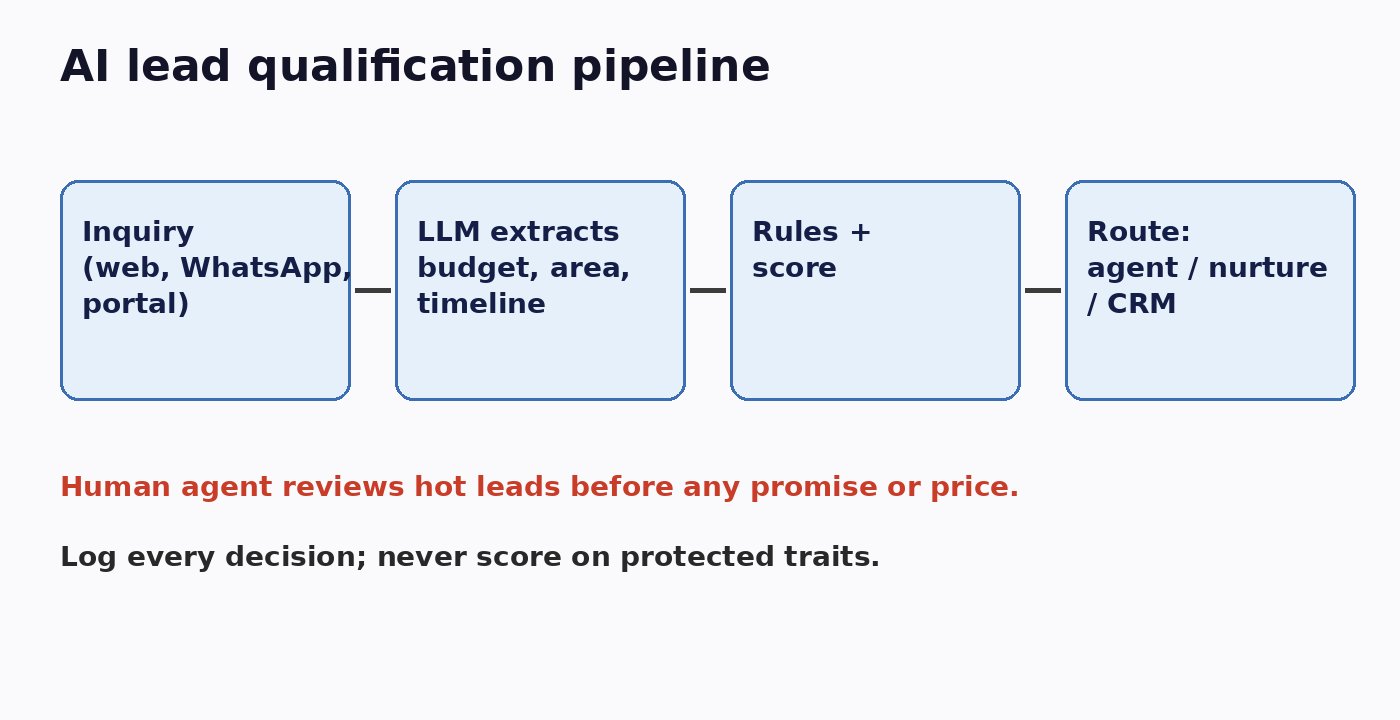
- Intake. Collect inquiries from web forms, portal emails, WhatsApp Business, and chat widgets into one queue.
- Extraction. An LLM turns free text into a structured profile such as intent, budget range, locations, bedrooms, and timeline.
- Conversation. If key fields are missing, the assistant asks short follow-up questions on the same channel.
- Scoring. Deterministic rules plus model signals produce a hot, warm, or nurture label.
- Routing. Hot leads go to an available agent with a summary; others enter nurture sequences in the CRM.
Step 1: Use Structured Extraction, Not Free Chat
Don't let the model answer however it likes. Define a JSON schema and ask the model to fill it, using your provider's structured output or function-calling feature:
{
  "intent": "buy | rent | sell | invest | unknown",
  "budget_min": number | null,
  "budget_max": number | null,
  "currency": "PKR | AED | USD | ...",
  "locations": string[],
  "property_type": "apartment | house | plot | commercial | unknown",
  "bedrooms": number | null,
  "timeline": "now | 1-3 months | 3-6 months | later | unknown",
  "financing": "cash | mortgage | unknown",
  "missing_fields": string[]
}
Validate the response in code. If parsing fails or values are out of range, retry once and then fall back to a human. Structured output makes the assistant predictable, testable, and easy to store.
Step 2: Ask Only the Questions That Matter
Use missing_fields to drive follow-ups, and ask one or two questions at a time. "Great, which areas are you considering, and roughly what budget?" works far better than a ten-question form. Keep the tone of your brand, reply in the language the lead used, and stop asking once you have enough to route.
Step 3: Ground Answers in Your Real Listings
Leads will ask about price, availability, and features. Never let the model guess. Retrieve facts from your listing database, ideally with semantic search over listings, and pass only those facts into the prompt. If the data isn't there, the assistant should say an agent will confirm. This keeps it from inventing prices or promising units that are already sold.
Step 4: Score With Rules You Can Explain
Combine simple, auditable rules with model signals. For example, a buyer with a budget that matches active inventory, a timeline under three months, and a confirmed phone number is hot. A vague renter with no budget is nurture. Keeping the scoring logic in code, not hidden inside a prompt, lets managers understand and tune it, and makes A/B testing straightforward.
Step 5: Hand Off to Humans Fast
The assistant's job is to qualify, not to close. When a lead becomes hot, notify an agent immediately with a short summary: what they want, budget, areas, timeline, and the full conversation. Speed matters; responding within five minutes dramatically raises conversion compared with responding in an hour. Let leads ask for a human at any time, and make that handoff seamless.
Guardrails You Need
- Fair housing and anti-discrimination. Never score or filter on protected characteristics such as religion, ethnicity, nationality, gender, or family status. Review prompts and rules for indirect bias.
- Privacy and consent. Store only what you need, tell users they are talking to an assistant, respect opt-outs, and follow local data protection law.
- No commitments. The assistant must not agree prices, reserve units, or give legal or mortgage advice.
- Logging and review. Keep transcripts and scores so you can audit decisions and fix bad behavior.
- Prompt injection. Treat lead messages as untrusted input; never let them change system instructions or trigger actions directly.
Measuring Whether It Works
Track time to first response, percentage of leads with complete profiles, agent hours saved, hot-lead to viewing conversion, and the share of leads that ask for a human. Compare against a period before launch. Also sample conversations weekly; numbers can look fine while the tone or accuracy quietly slips.
Conclusion
An AI lead qualification assistant gives real estate teams instant responses, consistent data, and a clear priority list, without replacing agents. Build it around structured extraction, grounded listing data, explainable scoring, and fast human handoff, and wrap it in strong guardrails for fairness and privacy. Start with one channel, measure carefully, and expand once the results are proven.