Off-plan property looks like a smart shortcut. You lock in today's price, pay in instalments while the building goes up, and collect the keys to a brand-new home or rental unit a few years later. When it works, buyers enjoy capital growth before they have even moved in. When it doesn't, they are left chasing a developer for refunds, waiting years past the promised handover date, or receiving an apartment that looks nothing like the brochure.
The difference between those two outcomes is rarely luck. It is due diligence: a set of checks you complete before you pay the booking deposit, not after. This guide walks through ten practical checks that protect your money, whether you are buying your first home or adding an investment unit to your portfolio.
Why Off-Plan Buying Needs Extra Care
With a finished property, you can walk through the rooms, test the taps, and see exactly what you are paying for. With off-plan, you are buying a promise. Your money is committed years before the asset exists, and most of the risk sits with you: construction delays, cost overruns, changes to the design, a weak property market at handover, or in the worst cases a developer who never finishes the project. Good due diligence turns that promise into something you can verify.
The 10-Point Off-Plan Due Diligence Checklist
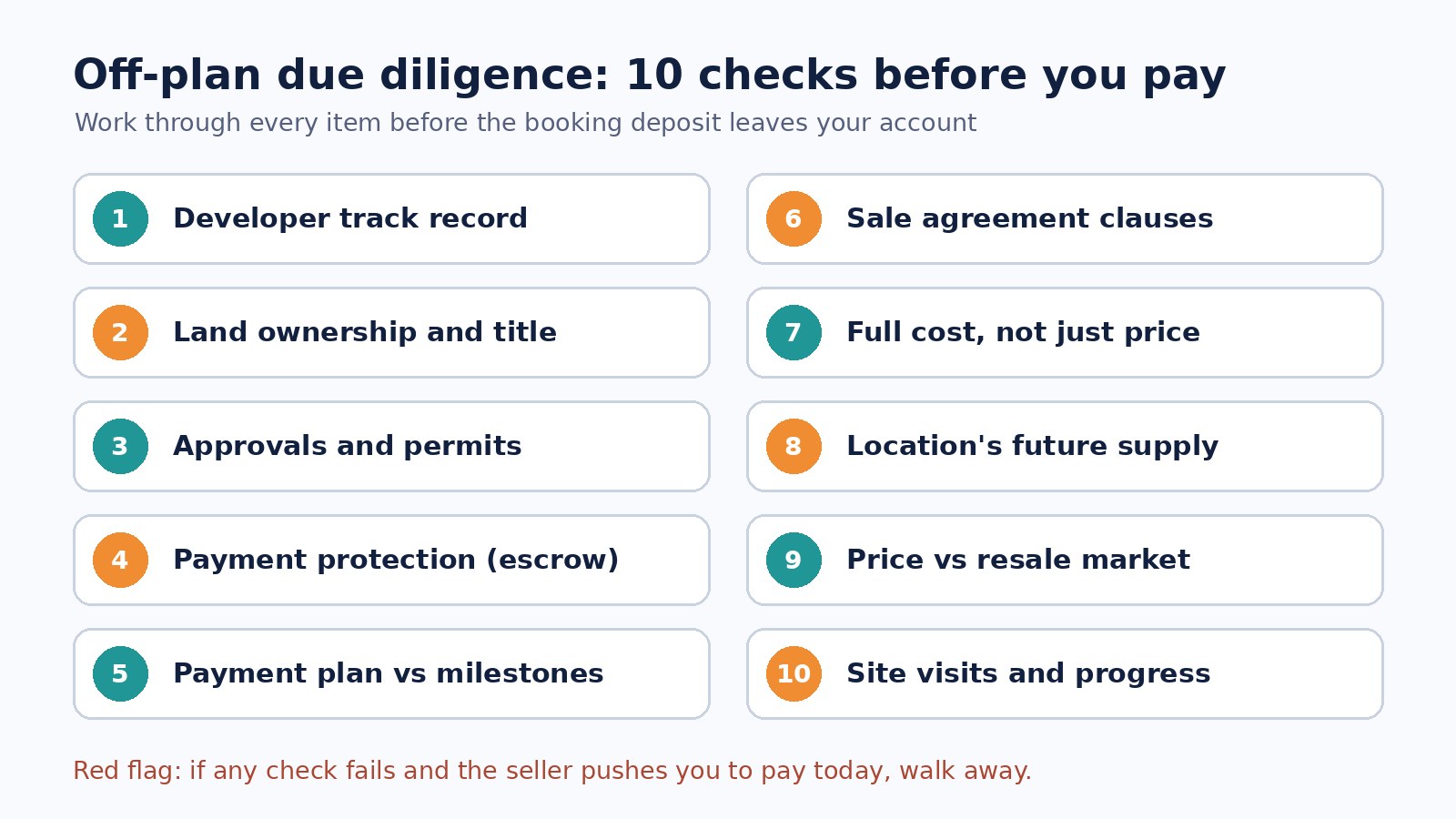
1. Research the Developer's Track Record
Start with the company, not the project. Look for completed developments, not just launched ones. Visit at least one finished building and talk to the residents if you can. Ask whether handovers were on time, whether the finishes matched what was sold, and how the developer handled defects after completion. A developer with ten launches and two completions is a warning sign, no matter how polished the sales gallery looks.
2. Confirm Land Ownership and Title
Ask for proof that the developer owns the land or has a legally valid agreement to build on it. Check that the land is free from disputes, mortgages, or unresolved claims. In many markets this means searching the land registry or the local development authority's records. If the developer cannot show clean title, stop there.
3. Verify Approvals and Permits
A project should have its building plan, layout, and zoning approvals in place before it starts selling units. Request copies of the approved plans and the approval reference numbers, then confirm them independently with the relevant authority. Projects sold on "approval in process" carry a much higher risk of redesigns, delays, or cancellation.
4. Check How Your Payments Are Protected
Find out where your instalments go. In regulated markets, buyer payments must be held in a project escrow account and released to the developer only as construction milestones are reached. Where escrow is not mandatory, ask what protection exists: a bank guarantee, insurance, or a clause allowing refunds if the project stalls. Never pay large amounts in cash or to a personal account.
5. Study the Payment Plan Against Construction Milestones
Healthy payment plans tie each instalment to visible progress, such as completion of the foundation, the structure, or the facade. Be cautious of plans that demand most of the price early while the site is still an empty plot. Build a simple spreadsheet of every payment date and amount so you know exactly how much cash you need each quarter and how exposed you are at each stage.
6. Read the Sale and Purchase Agreement Line by Line
The agreement matters far more than the brochure. Look for these clauses in particular:
Handover date and grace period: how late the project can be before penalties apply.
Delay compensation: what you receive if the developer misses the deadline, and whether you can cancel.
Specification changes: whether the developer can alter the unit size, layout, or materials without your consent.
Area variation: how much the final size can differ from the contracted size, and how the price adjusts.
Cancellation and refund terms: what happens to your money if either side walks away.
Pay a property lawyer to review it. The fee is small compared with the price of a mistake.
7. Calculate the Full Cost, Not Just the Price
The headline price is only part of the bill. Add registration and transfer fees, taxes, service or maintenance charges, parking, utility connection fees, furnishing, and the cost of any upgrades you want. If you are buying to rent, estimate realistic rent and vacancy for the area at the expected handover date, not today. A quick cost model will tell you whether the deal still makes sense once everything is included.
8. Evaluate the Location's Future, Not Just Its Present
Off-plan buyers are betting on what an area will look like in three to five years. Check planned roads, transport links, schools, hospitals, and commercial projects, and confirm they are actually funded and approved rather than just mentioned in marketing. Also look at upcoming supply: if thousands of similar units will hand over in the same neighbourhood at the same time, rents and resale prices may come under pressure.
9. Compare the Price With the Resale Market
Look up recent transaction prices for completed units in comparable buildings nearby. If an off-plan unit costs more than a ready one next door, you are paying a premium for waiting and taking construction risk. A fair off-plan price is usually at or below the ready market, which rewards you for that risk.
10. Visit the Site and Track Progress
Go to the site before you buy and keep visiting afterwards. Is there active construction, with workers and equipment, or is the plot quiet? Ask the developer for regular progress reports and photos, and compare them with what you see in person. Slow or stalled activity early on is often the first sign of financial trouble.
Red Flags That Should Make You Walk Away
Pressure to pay a deposit "today only" before you have seen any documents.
No approved plans, or approval numbers that cannot be verified.
Payments requested in cash or to an individual's account.
A sale agreement with no delay penalties and wide rights to change the specification.
Guaranteed returns that sound too good to be true.
A developer with many launches but few completed, occupied buildings.
How Technology Makes Due Diligence Easier
Many of these checks used to take weeks of phone calls and office visits. Today, buyers and agents can use online land registries, regulator databases of approved projects, transaction-price portals, and mapping tools to verify much of the information from a laptop. Developers and brokerages that publish transparent progress dashboards, digital document rooms, and online payment tracking earn trust faster. If you run a real estate business, building that transparency into your website or customer portal is one of the most effective ways to stand out in a crowded off-plan market.
Final Thoughts
Off-plan property can be a rewarding way to buy, but only when you treat the purchase as an investment decision rather than an emotional one. Check the developer, the land, the approvals, the payment protection, and the contract before you commit. Model the full cost, think about the area's future supply, and keep an eye on the site as it grows. A few hours of careful research today can save you years of stress and a great deal of money later.