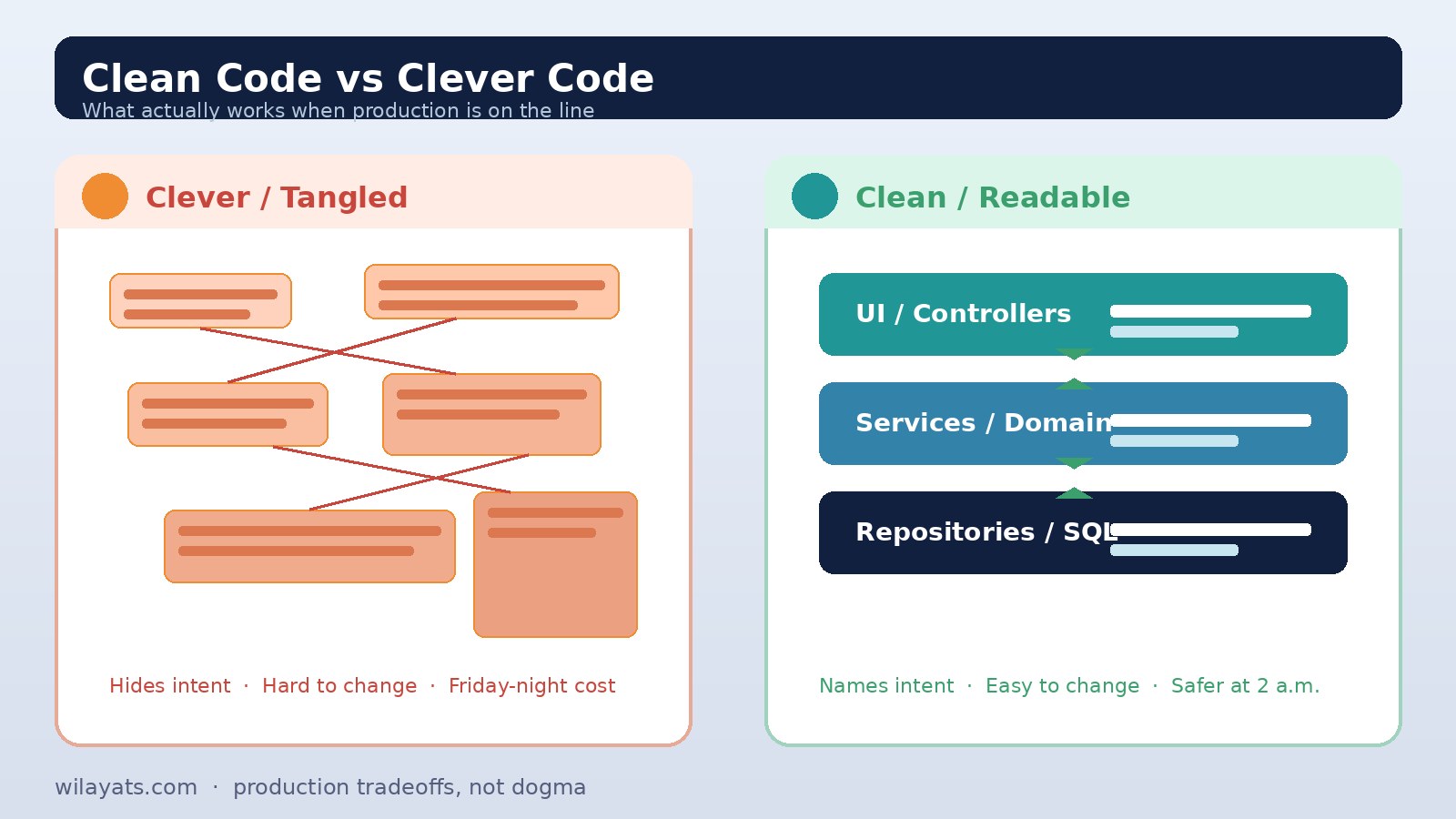
Friday night. A payment retry job starts failing in production. The stack trace points at a one-liner nobody remembers writing: a chain of map, filter, reduce, and a bitwise flag that "saves" three lines. Two hours later you have the bug—and a team that quietly agrees never to touch that file again. Clever code did not cause the outage alone. Clever code that hid intent made the outage expensive.
This is not a sermon against ingenuity. Production systems need sharp ideas: idempotent retries, careful locking, smart indexes. The question is whether the next engineer—or you in six months—can change the behavior without guessing. Clean code that stays readable and changeable wins. Clever code that obscures why something exists loses, even when it still "works."
What "Clever" Usually Means in a Pull Request
In reviews, clever often means dense: a nested ternary, a generic abstraction for one use case, a Redis key scheme only the author can decode, or a Laravel macro that looks like magic. Density is not the problem. Hidden intent is. If understanding a change requires reconstructing the author's private model of the world, you have cleverness that will fail the production ownership test.
Clean code, by contrast, is not verbose ceremony. It is code whose names, structure, and failure paths match the business rules your team already discusses in standups. That same clarity shows up when teams separate controller, service, and repository responsibilities—not because layers are fashionable, but because each layer answers a different question.
A Concrete Comparison: Order Status
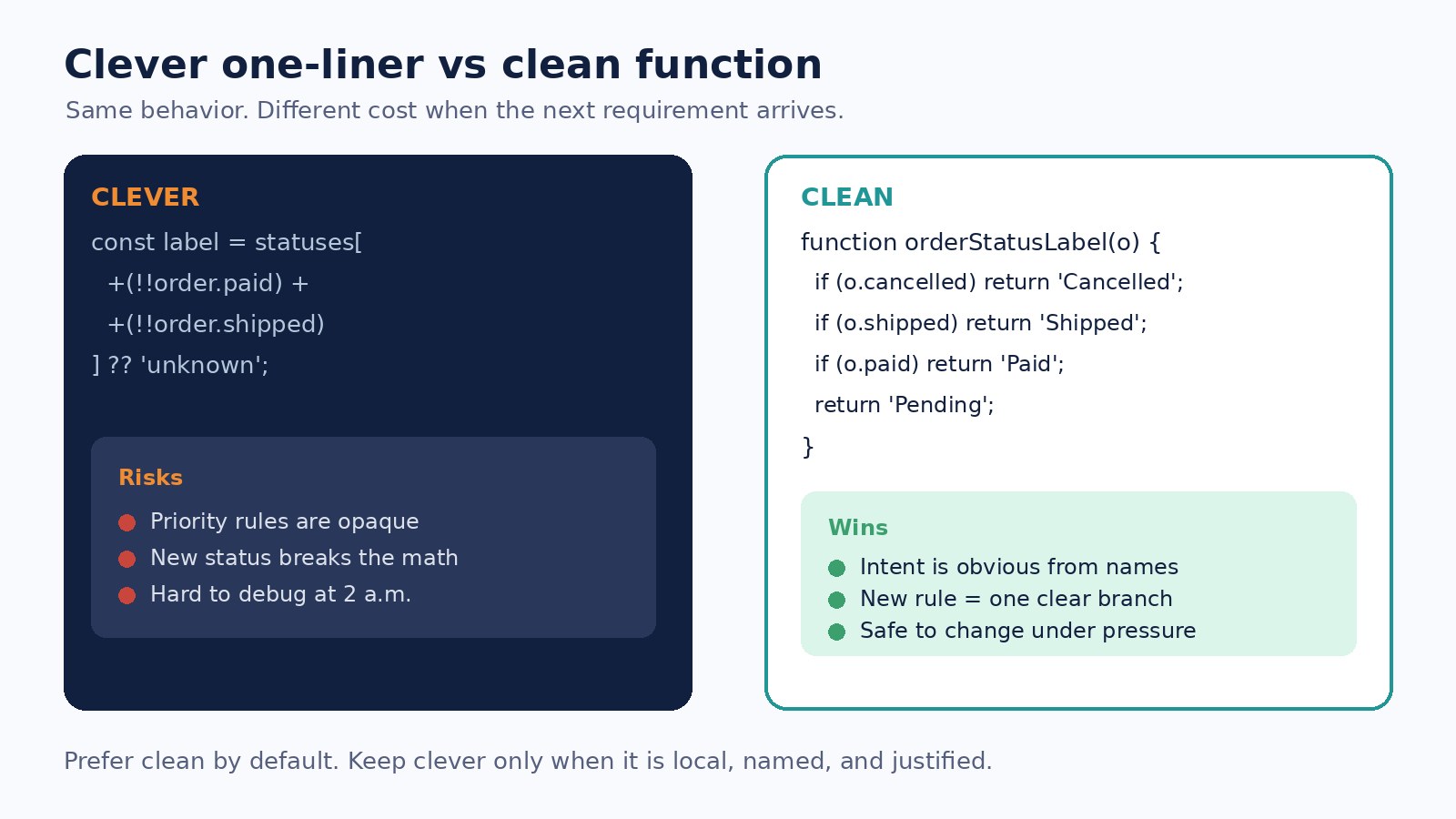
Suppose you need a label for an order in a React admin or a Laravel Blade view. The clever version packs state into an index. The clean version states the rules in order of priority.
Clever (impresses for five minutes)
const label = ['Pending', 'Paid', 'Shipped'][
  +(!!order.paid) + +(!!order.shipped)
] ?? 'Unknown';
Clean (survives the next requirement)
function orderStatusLabel(order: Order): string {
  if (order.cancelled) return 'Cancelled';
  if (order.shipped) return 'Shipped';
  if (order.paid) return 'Paid';
  return 'Pending';
}
Add a cancelled flag to the clever version and you are reverse-engineering arithmetic. Add it to the clean version and you insert one obvious branch. That is the production tradeoff: a few extra lines now versus hours of archaeology later.
When Clever Is Actually the Right Call
Clever is not always bad. Prefer a sharp technique when it is local, named, and justified:
Local: the trick lives inside one function or module, not spread across the codebase.
Named: a function or type name carries the intent (
acquireLeaseOrSkip, notdoThing).Justified: there is a measurable reason—correctness under concurrency, a hot path, or a clear domain invariant.
Example: a PostgreSQL advisory lock around a invoice number allocator is "clever" compared to a naive MAX(id)+1 in PHP. It is also the right kind of clever—documented, isolated, and protecting a real invariant. The wrong kind is a bitwise encoding of invoice states so the author can avoid a lookup table.
// Right kind of clever: clear name, clear contract
public function nextInvoiceNumber(int $tenantId): string
{
    return DB::transaction(function () use ($tenantId) {
        DB::select('SELECT pg_advisory_xact_lock(?)', [$tenantId]);
        $seq = TenantSequence::query()
            ->where('tenant_id', $tenantId)
            ->lockForUpdate()
            ->firstOrFail();
        $seq->increment('invoice_seq');
        return sprintf('INV-%s-%06d', $tenantId, $seq->invoice_seq);
    });
}
Clever Abstractions That Age Badly
Premature frameworks are a common failure mode. One discount rule becomes IRuleEngine<TContext, TResult> with plugins nobody asked for. Six months later every price change touches three interfaces and a registry. This is the same pattern that shows up in unmaintainable structure: god modules, fuzzy boundaries, and fear of changing hot files.
A useful rule of thumb: wait for the second real use case before extracting a shared abstraction. Until then, a plain function with a domain name is cleaner than a clever generic. That habit is part of what separates junior and senior developer code—seniors size the piece to the problem, not to an imaginary plugin system.
Over-abstracted
interface IDataProcessor<TIn, TOut> {
  process(input: TIn): TOut;
}
class DiscountProcessorFactory {
  create(): IDataProcessor<Cart, Cart> { /* ... */ }
}
Right-sized
function applyVolumeDiscount(cart: Cart): Cart {
  if (cart.lineCount < 10) return cart;
  return { ...cart, totalCents: Math.round(cart.totalCents * 0.95) };
}
Production Checklist: Clean vs Clever
Before you merge a dense change, ask:
Can a teammate explain the behavior from the names alone?
If a new status, currency, or tenant rule arrives next month, where does the edit go?
Are failure modes explicit (timeout, insufficient funds, lock not acquired) or swallowed?
Would you be comfortable debugging this at 2 a.m. without the author on Slack?
Is the cleverness solving a measured constraint, or saving keystrokes?
If answers 1–4 are weak, rewrite for clarity. If answer 5 is a real constraint (throughput, correctness under race), keep the technique—but wrap it in a boring name and a short comment that states the invariant, not the implementation.
Clean Does Not Mean Slow or Naive
Teams sometimes hear "clean" as "simple to the point of wrong." That is a false trade. Clean code can still use Redis pipelines, composite indexes, and careful React state. The difference is that the optimization is visible: a named cache key, a repository method findActiveLeasesForTenant, a query with an explainable WHERE clause—not a one-liner that mutates three globals to shave a line count.
In ERP-style Laravel apps, clean usually looks like: thin controllers, services that own workflows, repositories that own SQL, and domain functions that stay pure enough to unit test. Clever that fights that grain—controllers that speak Redis and Blade in the same method—becomes unmaintainable structure under load.
Conclusion
Production does not reward how impressive a line looks in review. It rewards code you can change safely when requirements shift. Prefer readable, named, changeable solutions by default. Reach for clever techniques when they are local, named, and justified by a real constraint—and make the intent obvious so the next engineer inherits a tool, not a puzzle. Write for the Friday-night debugger. That person is usually you.