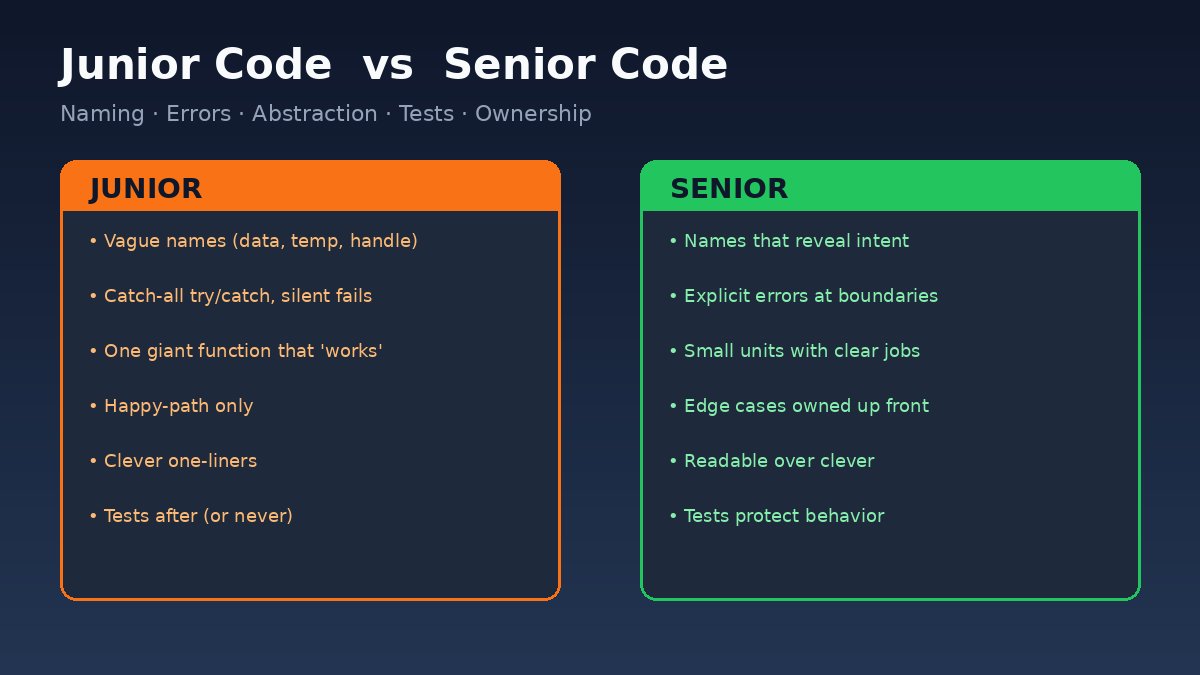
The gap between junior and senior developer code is rarely about knowing more syntax. Both can make a feature work. The difference shows up six months later: one change is a quiet edit, the other is a weekend of archaeology. Seniors write code that names intent, owns failure modes, and stays readable when the next requirement arrives.
This article focuses on concrete habits you can see in a pull request—naming, error handling, abstraction, tests, edge cases, and ownership—with before-and-after snippets you can apply in React, Laravel, or any stack your team uses.
Naming: Does the Code Explain Itself?
Juniors often name things after what they are doing in the moment: data, temp, res, handleClick. Seniors name things after what they mean in the domain.
Before (junior)
async function getData(id) {
  const res = await fetch(`/api/orders/${id}`);
  const data = await res.json();
  return data;
}
After (senior)
async function fetchOrderById(orderId: string): Promise<Order> {
  const response = await fetch(`/api/orders/${orderId}`);
  if (!response.ok) {
    throw new OrderNotFoundError(orderId);
  }
  return response.json();
}
The senior version reveals the business concept (an order), the identifier type, the return type, and what happens when the order is missing. You do not need a comment to understand it. That same instinct—clear names and clear ownership of logic—shows up when teams decide where controller, service, and repository code should live.
Error Handling: Own the Failure Modes
Junior code often assumes the happy path. When something fails, a broad try/catch logs a generic message—or swallows the error entirely. Senior code treats failures as part of the design: which errors are expected, which are bugs, and where each one should surface.
Before (junior)
try {
  await chargeCustomer($customerId, $amount);
} catch (\Exception $e) {
  // ignore — we will retry later somehow
}
After (senior)
try {
  $this->payments->charge($customerId, $amount);
} catch (InsufficientFunds $e) {
  throw new PaymentDeclined($customerId, $e->getMessage());
} catch (PaymentGatewayTimeout $e) {
  $this->queue->retryCharge($customerId, $amount);
  throw $e;
}
Seniors distinguish business failures (declined card) from infrastructure failures (timeout). They decide whether to retry, alert, or fail the request. Juniors often leave that decision for "later," which means production becomes the decision-maker.
Abstraction Level: Not Too Little, Not Too Much
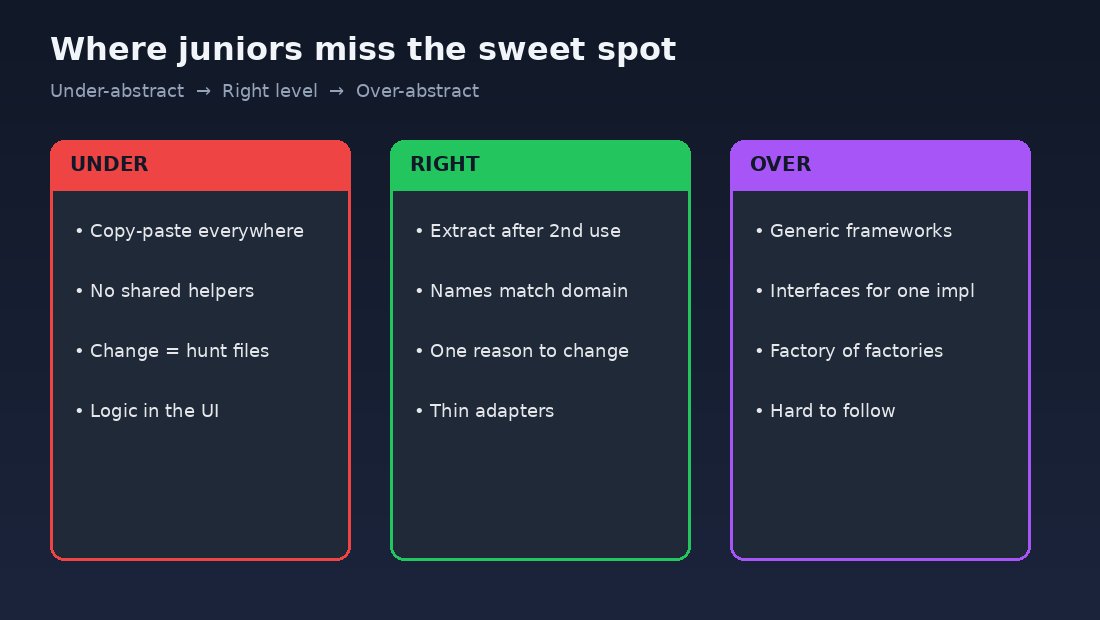
Two opposite mistakes look very different but hurt the same way.
- Under-abstraction: the same validation or mapping is copy-pasted in five places. A rule change means hunting files.
- Over-abstraction: a generic framework, interfaces with one implementation, and factories of factories for a single use case. Nobody can follow the path from request to database.
Seniors wait for the second real use case before extracting shared code. They prefer a clear domain name over a clever generic one. That judgment is part of how senior developers break down complex problems before writing code—they size the pieces so each one has one job, without inventing a plugin system for imaginary futures.
Before (over-abstracted junior energy)
interface IDataProcessor<TIn, TOut> {
  process(input: TIn): TOut;
}
class OrderProcessorFactory {
  create(): IDataProcessor<RawOrder, Order> { /* ... */ }
}
After (right-sized)
function normalizeOrderPayload(raw: RawOrderPayload): Order {
  return {
    id: raw.order_id,
    totalCents: Math.round(raw.total * 100),
    status: mapStatus(raw.status),
  };
}
A plain function with a domain name beats a generic processor until you truly have multiple processors.
Edge Cases: Design for Reality, Not the Demo
Junior solutions often work for the demo data: one user, one currency, one happy path. Seniors ask what happens when the list is empty, the ID is missing, the payment is double-submitted, or two requests race.
- Empty collections and nulls at API boundaries
- Idempotency for payments and webhooks
- Concurrent updates (optimistic locking or unique constraints)
- Partial failure in multi-step workflows
You do not need to handle every possible universe on day one. You do need to decide which edge cases matter for this feature and encode them—in validation, in the database, or in tests—so they are not rediscovered in production.
Readability vs Cleverness
Clever code impresses in a code review for five minutes. Readable code pays for itself every time someone debugs at 2 a.m. Seniors prefer an obvious if over a dense one-liner when the dense version hides intent.
Before (clever)
const label = statuses[+(!!order.paid) + +(order.shipped)] ?? 'unknown';
After (clear)
function orderStatusLabel(order: Order): string {
  if (order.shipped) return 'Shipped';
  if (order.paid) return 'Paid';
  return 'Pending';
}
The clear version is longer and better. Teams that prize cleverness also tend to accumulate the kind of tangled React effects described in why too many useEffect hooks are a code smell—behavior that works until you need to change one branch safely.
Tests: Protect Behavior, Not Implementation
Juniors sometimes write no tests, or they write tests that mirror every private method and break on every refactor. Seniors write tests that lock down the contract: given this input and this state, the system produces this outcome.
it('declines charge when balance is insufficient', async () => {
  await wallet.seed(customerId, { balanceCents: 100 });
  await expect(payments.charge(customerId, 500))
    .rejects.toBeInstanceOf(PaymentDeclined);
});
That test still passes if you rename internals. It fails if you accidentally charge anyway. That is the difference between tests as a tax and tests as a safety net—and it is one reason software can absorb years of new requirements without freezing, as covered in how to build software that survives five years of change.
Ownership: Who Is Responsible When It Breaks?
Junior code often stops at "it works on my machine." Senior code answers: How will we know it failed? Who gets alerted? Can we retry safely? Is there an audit trail?
- Structured logs with correlation IDs
- Metrics for success and failure rates
- Clear user-facing messages for expected errors
- No silent catches that hide outages
Ownership is not a personality trait. It is code that makes failure visible and recoverable.
A Practical Checklist for Your Next PR
- Would a teammate understand the names without opening five files?
- Are expected failures explicit (types, exceptions, status codes)?
- Is the abstraction matching a real second use case, not a hypothetical one?
- Did you cover the empty, null, and double-submit cases that matter here?
- Is the clever bit still readable at midnight?
- Do tests protect behavior rather than private structure?
Conclusion
Junior code proves you can solve the problem. Senior code proves you can live with the solution. Focus on names that carry domain meaning, errors that are owned at the right boundary, abstractions that earn their keep, edge cases that match reality, and tests that protect behavior. Those habits matter more than any title on a résumé—and they show up in every line you ship.