Most software doesn't die because the first version was wrong. It dies because, three years later, every new requirement takes weeks, every release breaks something unrelated, and nobody dares to touch the core. The business keeps changing: new pricing models, new markets, new integrations, new regulations. Software that survives five years isn't software that predicted all of that. It is software that made change cheap.
Accept That Requirements Will Change
The biggest mistake is designing for a fixed specification. In year one, you are told invoices have one currency, users belong to one company, and there is one payment provider. By year three, all three assumptions are false. You can't predict which assumptions will break, but you can keep each assumption in one place so breaking it is a local change instead of a rewrite.
1. Organize Code Around the Business, Not the Framework
Folders named controllers, models, and services tell you which framework you use, not what the system does. Group code by business capability instead: billing, orders, inventory, users. When a requirement changes in billing, most edits stay inside the billing module. This is the core idea behind a modular monolith, which we compared in Monolith vs Modular Monolith vs Microservices.
2. Protect a Stable Core From Changing Edges
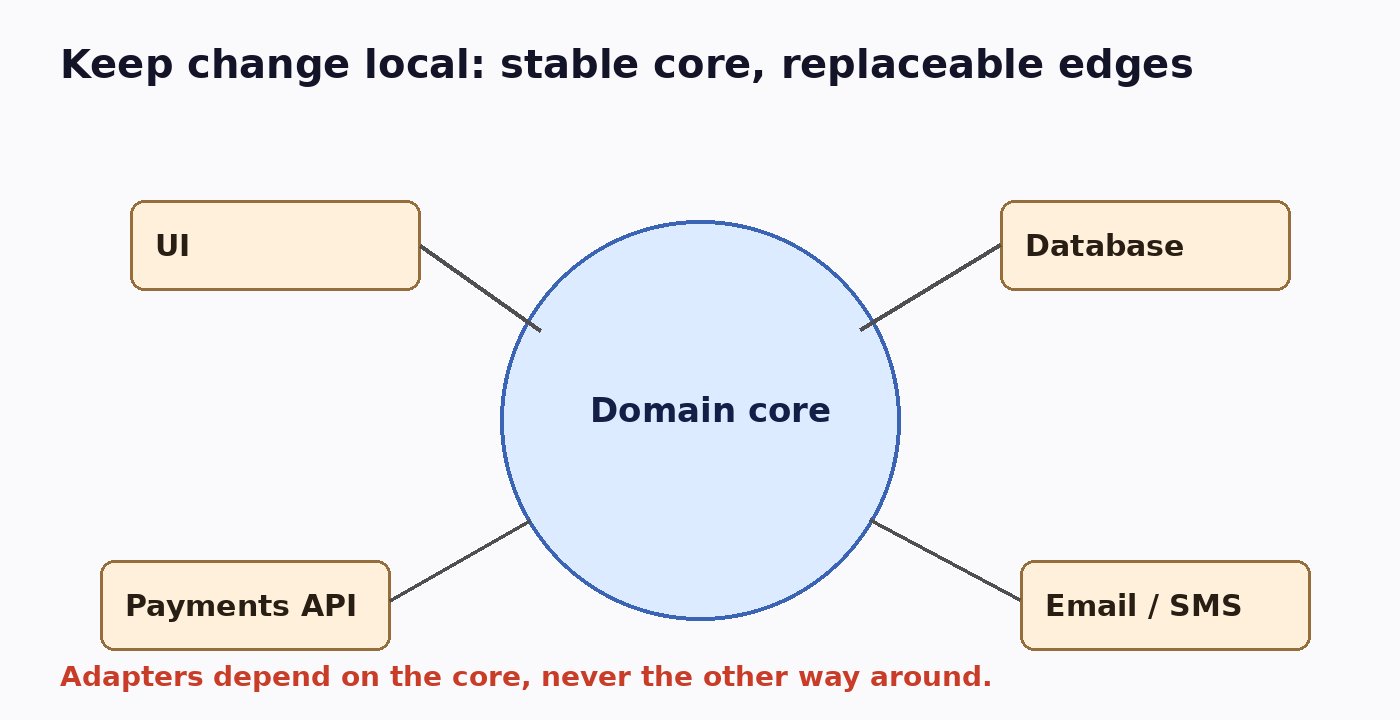
Business rules change for business reasons. Databases, UI frameworks, payment gateways, and email providers change for technical or commercial reasons. Keep them apart. Put domain rules in plain code with no framework imports, and connect the outside world through small adapters. When you switch from one payment provider to another, you write a new adapter; the order logic doesn't move. Knowing where each piece of logic belongs is essential here, and Controller vs Service vs Repository walks through it in detail.
3. Make Boundaries Explicit
Modules should talk through clear interfaces, not by reaching into each other's tables or internals. A billing module should ask the orders module for an order summary through a public function or event, not query the orders table directly. Explicit boundaries let you rewrite one module, or extract it into a service later, without touching the others.
4. Prefer Configuration and Data Over Hard-Coded Branches
When you see if (country === 'PK') scattered across the codebase, every new country becomes a search-and-edit project. Move rules that vary by customer, region, or plan into data: tax tables, feature flags, plan definitions, and strategy objects. New requirements then often mean new rows or a new strategy class, not edits to twenty files.
5. Design Your Data Model for Growth
Data outlives code. A few early decisions save years of pain:
- Store money as integer minor units with an explicit currency, never as floats.
- Store timestamps in UTC and keep the user's time zone separately.
- Avoid one-to-one assumptions that are really one-to-many, such as a user with exactly one address or one company.
- Use versioned, reversible migrations and never edit old ones.
- Keep audit fields like created_at, updated_at, and who made the change.
6. Write Tests That Protect Behavior, Not Implementation
Tests are what make change safe. But tests that mirror every private method break on every refactor and get deleted. Focus on behavior: given this order and this coupon, the total is this amount. Cover the domain core thoroughly, add integration tests around adapters, and keep a small set of end-to-end tests for critical journeys like signup and checkout.
7. Version Your APIs and Events
Mobile apps, partners, and other teams depend on your contracts and can't all upgrade on your schedule. Add fields instead of renaming them, version breaking changes, deprecate with clear timelines, and document every public endpoint and event. A stable contract lets the inside of your system change freely.
8. Pay Down Technical Debt Continuously
Debt is normal; unmanaged debt is fatal. Reserve part of each sprint for refactoring, follow the boy-scout rule of leaving code a little cleaner than you found it, and track known hotspots: files that change most often and break most often. Fixing the top five hotspots usually delivers more than any big rewrite.
9. Make the System Observable
You can't safely change what you can't see. Structured logs, metrics, tracing, and error tracking tell you whether a change broke something within minutes, not weeks. Feature flags let you release new behavior gradually and roll it back without a deploy.
10. Write Down Decisions
Five years is longer than many developers stay on a team. Short architecture decision records explaining what you chose, the alternatives, and why, stop future developers from undoing good decisions or repeating bad ones. Pair them with a clear README and onboarding guide.
Avoid the Opposite Trap: Over-Engineering
Surviving change doesn't mean building generic plugin systems for requirements nobody has asked for. Speculative abstractions are their own kind of debt. Build the simplest thing that keeps responsibilities separated, and add flexibility when the second real use case appears. The habit of breaking problems into small, clear parts, described in How Senior Developers Break Down Complex Problems Before Writing Code, matters more than any pattern.
Conclusion
Software that lasts five years is organized around the business, protects a stable core from changing edges, keeps boundaries explicit, puts varying rules in data, and is backed by behavior-focused tests, versioned contracts, and good observability. None of this requires predicting the future. It only requires making each future change small, local, and safe.