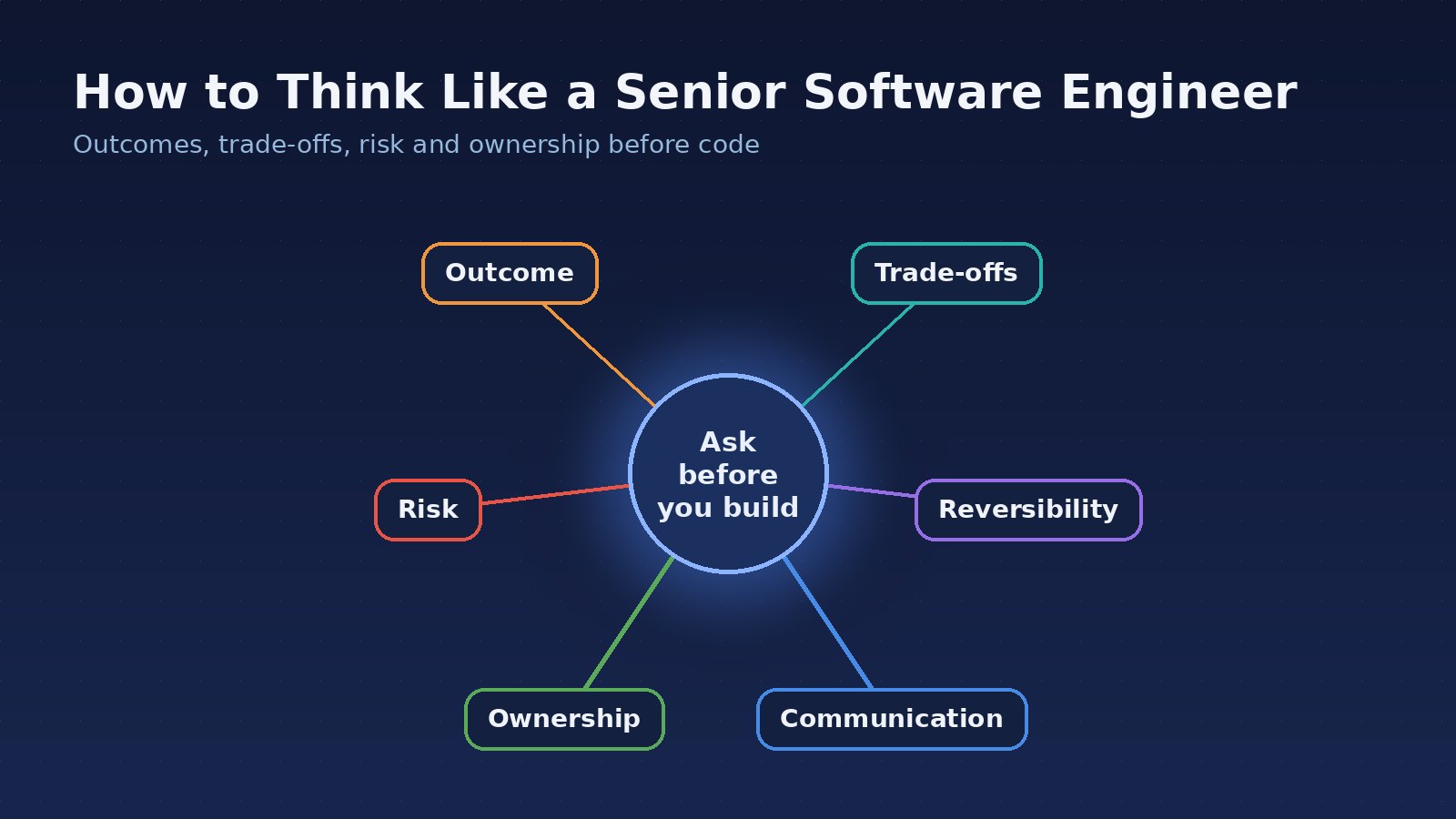
Most developers assume the jump to senior is about knowing more: more frameworks, more patterns, more shortcuts in the editor. Knowledge helps, but it is not what people notice when they work with a strong senior engineer. What they notice is how that person thinks: the questions they ask before building, the risks they spot early, and the calm way they make decisions when the requirements are fuzzy.
The good news is that this way of thinking can be learned. This article breaks it down into habits you can practise on your next ticket, whether you work on a React front end, a Laravel API or a large ERP system. If you want the code-level side of the story, see The Difference Between Junior and Senior Developer Code. Here we focus on the thinking that comes before the code.
1. Start With the Outcome, Not the Task
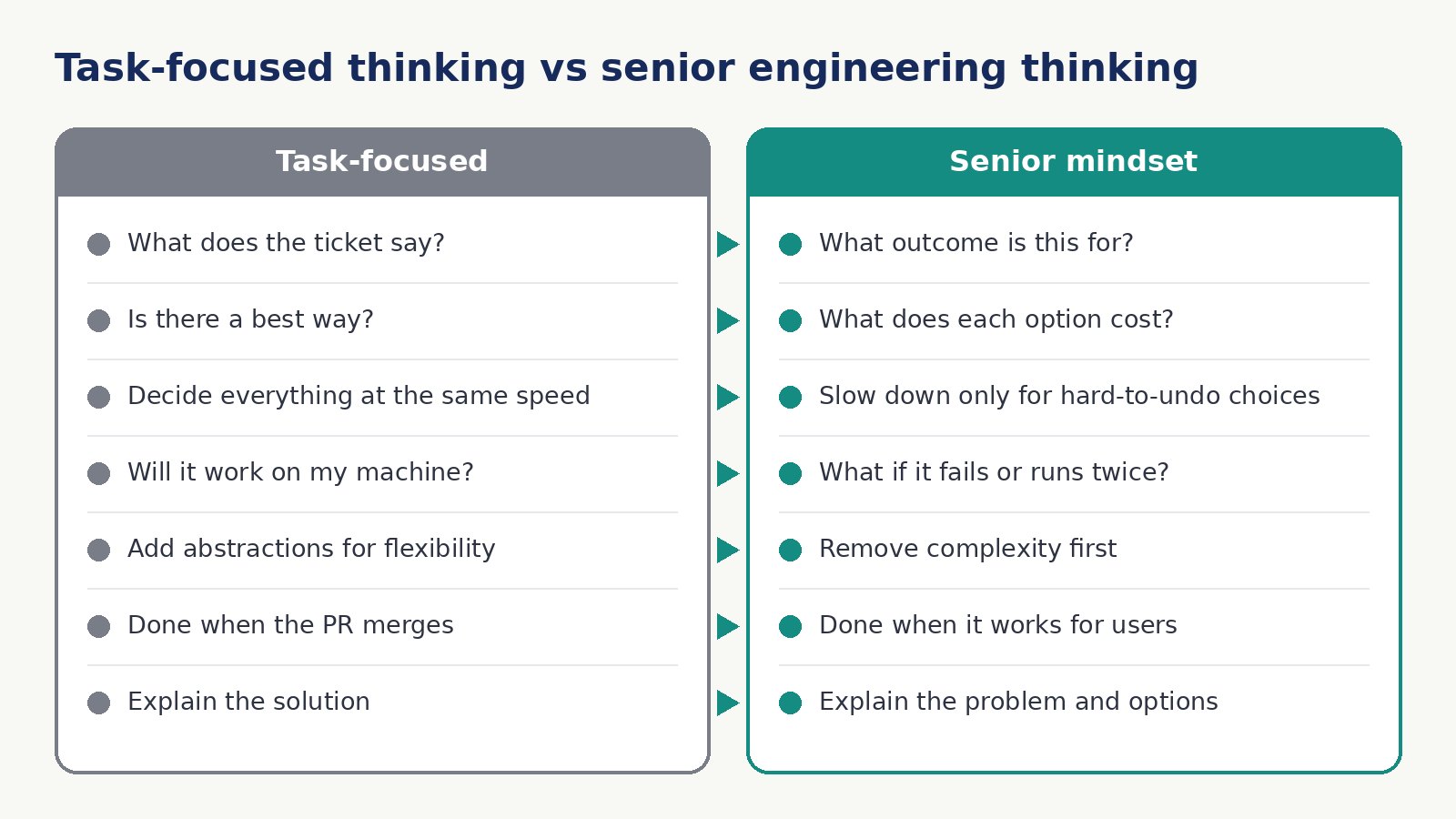
A ticket says "add an export button to the invoices page." A junior mindset reads that as the whole job. A senior mindset asks what the export is for. Is the finance team reconciling payments in a spreadsheet every week? Then maybe they need a scheduled report, not a button. Is an auditor asking for a one-off file? Then a simple CSV is enough and a polished feature would be wasted effort.
Asking "what problem does this solve, and for whom?" often shrinks the work, sometimes grows it, and almost always makes the result more useful. It also gives you a way to judge whether you are done: the outcome is reached, not just the checkbox ticked.
Questions worth asking before you start
- Who uses this, and what are they trying to get done?
- What happens today without this feature?
- How will we know it worked?
- What is the smallest version that delivers most of the value?
2. Think in Trade-offs, Not Right Answers
Senior engineers rarely say "this is the best way." They say "this option is faster to ship but harder to change later" or "this is more work now but removes a whole class of bugs." Every technical choice trades something: speed against flexibility, simplicity against performance, consistency against autonomy.
When you catch yourself arguing for a solution, try writing down what it costs. Caching a PostgreSQL query in Redis makes reads faster, but now you own cache invalidation and stale data. Splitting a module into its own service gives a team independence, but adds network calls, deployment work and distributed failures. Naming the cost does not mean rejecting the idea. It means choosing it with open eyes and being able to explain the choice to others.
3. Separate Reversible Decisions From Irreversible Ones
Not every decision deserves the same amount of thought. A useful filter is to ask: how expensive is it to undo this?
- Cheap to reverse: the name of a private function, the layout of a settings page, which state library a single component uses. Decide quickly, move on, fix later if needed.
- Expensive to reverse: a public API contract other teams depend on, a database schema holding millions of rows, the tenancy model of a SaaS product, the format of IDs stored in other systems. Slow down, write it up, get a second opinion.
Juniors often spend a day debating a variable name and five minutes on a table design. Seniors do the opposite. Matching effort to reversibility is one of the simplest habits with the biggest payoff.
4. Ask "What Could Go Wrong?" Early
Senior engineers have usually been paged at night, so they think about failure before it happens. That is not pessimism. It is cheaper to handle a problem in design than in production.
Before shipping, run through a short mental checklist:
- What happens if this external API is slow or returns an error?
- What if the same request arrives twice, for example a double-clicked "Pay" button or a retried queue job?
- What if the input is empty, huge, or in an unexpected format?
- How will I know it is broken? Is there a log line, a metric or an alert?
- How do I roll this back if it goes wrong?
A small example: a background job that charges customers should be safe to run more than once. Thinking about that up front leads to a simple guard instead of a painful incident.
public function handle(): void
{
    // Idempotency: skip if this invoice was already charged.
    if ($this->invoice->fresh()->charged_at !== null) {
        return;
    }

    DB::transaction(function () {
        $this->gateway->charge($this->invoice);
        $this->invoice->update(['charged_at' => now()]);
    });
}
Notice that the guard only helps if the job checks fresh data, and a real payment flow would also pass an idempotency key to the gateway. The point is not this exact code. The point is that someone asked "what if this runs twice?" before a customer was charged twice.
5. Reduce Complexity Instead of Managing It
It is tempting to show skill by building something sophisticated: a generic plugin system, a custom event bus, five layers of abstraction "for flexibility." Senior engineers are usually suspicious of their own cleverness. They know every abstraction is something the next developer has to learn and maintain.
A good test is to ask whether a new piece of code makes the system easier to understand. If a simple function and a clear name would do, use them. Add structure when real, repeated needs appear, not when you imagine they might. Often the most senior contribution in a pull request is a deleted file.
6. Make Problems Smaller Before Solving Them
Big, vague problems freeze people. Seniors break them into pieces they can test and ship one at a time: first make the data model correct, then the API, then the UI, then the edge cases. Each step is small enough to review and safe to deploy behind a feature flag if needed. We covered this skill in depth in How Senior Developers Break Down Complex Problems Before Writing Code.
7. Own the Result, Not Just the Code
Ownership is the trait people most often mention when they describe a senior colleague. It means your job is not finished when the pull request merges. It is finished when the feature works for real users. In practice, that looks like:
- Checking logs and error tracking after a deploy instead of assuming it went fine.
- Following up when a bug you fixed reappears, and looking for the root cause rather than patching the symptom again.
- Updating documentation, migration notes or the runbook so the next person does not get stuck.
- Raising a concern early when a deadline looks unrealistic, instead of quietly hoping it works out.
8. Communicate So Others Can Decide
A lot of senior work is communication: explaining a risk to a product manager, writing a clear design note, or leaving a code review comment that teaches instead of just correcting. The goal is to give others enough context to make good decisions without you in the room.
Useful habits include stating the problem before the solution, listing the options you considered and why you rejected them, and being explicit about uncertainty ("I think this will take three days, but the payment provider's sandbox is an unknown"). Clear writing scales your thinking to people you will never pair with.
9. Multiply the Team, Not Just Your Output
Finally, senior engineers measure their impact by how much better the team gets, not only by how many tickets they close. They pair with newer developers, add a missing test helper that everyone can reuse, automate a painful deployment step, or turn a recurring question into a short internal guide. These contributions rarely show up in a sprint report, but they compound over time.
How to Practise This Starting Tomorrow
You do not need a new title to think like a senior engineer. Pick one habit per week and apply it deliberately:
- Before your next ticket, write one sentence describing the outcome it should achieve.
- In your next design or pull request, list at least one trade-off you accepted.
- Before shipping, answer "what happens if this runs twice or fails halfway?"
- After deploying, check the logs the next morning.
- Write a short summary of a decision you made, so someone else could understand it six months from now.
Over time these questions become automatic. That is the real difference: senior engineers are not people who never make mistakes. They are people who have built the habit of asking the right questions early, when the answers are still cheap.