Most buyers lose money on a home before they ever sign anything. They fall in love on the first visit, tell the seller's agent how much they like the place, and then make an offer based on the asking price instead of on what the property is actually worth. The good news is that negotiation is not a talent. It is a process, and you can follow it step by step.
This guide walks you through that process: how to work out a fair price, how to collect leverage, how to make your first offer, and how to handle counteroffers without losing the deal or overpaying.
Step 1: Separate the asking price from the real value
The asking price is the seller's opinion, often padded to leave room for bargaining. Your job is to build your own number from evidence.
Recent comparable sales. Look for 3 to 5 similar properties in the same area, of similar size and age, that actually sold (or were transferred) in the last 6 to 12 months. Actual sale prices matter far more than other listings' asking prices.
Price per square foot (or per marla). Convert every comparable to a per-unit price, then apply it to the property you are looking at. This quickly shows whether the asking price is in line or inflated.
Adjustments. Add or subtract for real differences: corner plot, park-facing, newer construction, extra floor, poor layout, road noise, or a needed renovation.
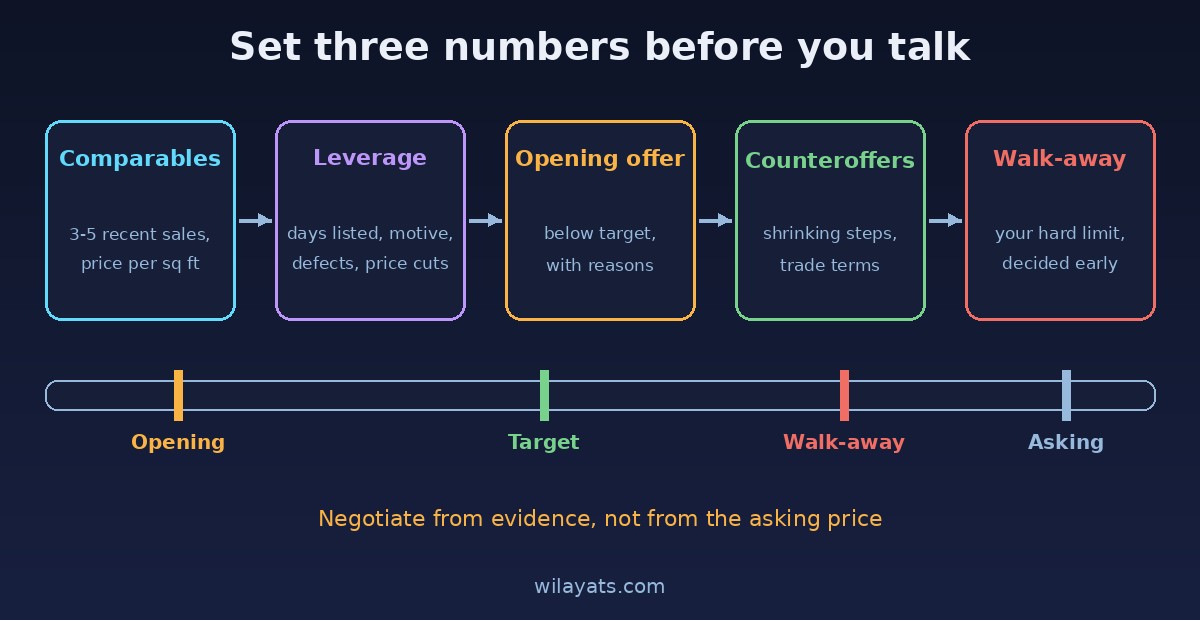
Write down three numbers before you talk to anyone: your target price (what the evidence says it is worth), your opening offer, and your walk-away price. The walk-away number is the most important one. Decide it while you are calm, not in the middle of a bidding conversation.
Step 2: Collect leverage before you make an offer
Leverage is any fact that makes the seller more willing to accept less. You find it by asking simple questions and paying attention.
How long has it been on the market? A property listed for months with no takers gives you room. A fresh listing in a hot area gives you less.
Why is the owner selling? Relocation, an inheritance split between family members, or a seller who has already bought another home usually means they value speed and certainty over the last bit of price.
Has the price already dropped? A previous reduction tells you the seller has tested the market and it pushed back.
What is wrong with it? Seepage, cracks, old wiring, weak water pressure, missing approvals, or pending dues are all legitimate reasons for a lower price. Inspect carefully, and get a professional opinion for anything structural.
Every defect you document becomes a reasoned argument rather than a lowball. "The roof needs waterproofing, which costs roughly X" is much harder to dismiss than "Can you do better?"
Step 3: Make a strong first offer
Your first offer anchors the whole conversation, so it should be low enough to leave room to move but grounded enough that the seller takes it seriously.
Anchor below your target. A common approach is to open somewhere between your target price and a figure supported by your weakest comparables. The exact gap depends on the market: in a slow market you can open lower, in a fast one stay closer to value.
Explain your number. Share the comparables and the repair estimates. Sellers react far better to an offer that comes with reasons.
Show you are ready. Proof of funds or a loan pre-approval, a quick timeline, and a token amount ready to pay make your offer more attractive than a slightly higher but uncertain one.
Put it in writing. A written offer with price, payment schedule, possession date, and conditions looks serious and avoids later "that's not what I said" arguments.
Step 4: Handle counteroffers calmly
Expect the seller to counter. That is normal and it means they are engaged. A few habits keep you in control:
Move in shrinking steps. If your first raise is large and the next ones get smaller, you signal that you are approaching your limit. Equal or growing jumps tell the seller there is more to come.
Trade, don't just concede. If you give on price, ask for something back: fixtures and fittings left in place, the seller covering certain transfer or utility costs, a faster or slower possession date, or repairs completed before handover.
Use silence and time. You do not have to answer a counteroffer on the spot. "Let me think about it and get back to you tomorrow" is a complete sentence.
Keep emotions out of the room. Avoid telling the seller or their agent that this is your dream home. Enthusiasm is information, and it costs you money.
Step 5: Negotiate more than the price
The headline price is only one part of the deal. Sometimes a seller who refuses to drop the price will happily agree to terms that save you just as much:
A longer payment schedule, which can matter more than a small discount if you are arranging funds.
Who pays which fees, dues, and transfer-related costs.
Clearing all outstanding utility bills, maintenance charges, and society dues before transfer.
Which appliances, air conditioners, fittings, and furniture stay with the property.
A clear penalty or refund clause if the seller backs out after taking your token money.
Step 6: Know when to walk away
Your walk-away price exists for a reason. If the negotiation passes it, thank the seller and leave politely. Two things often happen next: either the seller calls back a few days or weeks later, or you find another property that fits just as well. Very few homes are truly one of a kind, even if they feel that way during a visit.
Walk away immediately, regardless of price, if the documents do not check out, the seller refuses a proper inspection, or you are being pressured to pay a large amount before the paperwork is verified.
Common mistakes buyers make
Negotiating from the asking price instead of from evidence.
Revealing their maximum budget early.
Skipping the inspection to "save time" and then discovering expensive problems after paying.
Paying token money before verifying ownership and documents.
Letting a fear of losing the property override the walk-away number.
A quick pre-offer checklist
I have 3 to 5 recent comparable sales and a per-unit price.
I know my target, opening, and walk-away prices.
I have inspected the property and priced any repairs.
I know roughly why and how urgently the owner is selling.
My funds or loan approval are ready, and my offer is in writing.
Ownership documents and dues have been verified, or verification is a condition of the deal.
Final thoughts
Good negotiation is mostly preparation. When you know what the property is really worth, why the seller is selling, and exactly where you will stop, the conversation stops being stressful and becomes a simple exchange of reasons. You may not win every deal, but you will never again overpay because you were in a hurry or in love with a kitchen.

Comments
Join the discussion. Replies load on demand, up to 5 levels.
0 threads
No comments yet
Be the first to start the conversation.