
"Rent is dead money." "Buying is always the smart move." You have probably heard both from relatives, colleagues and property agents. The truth is less exciting: whether renting or buying is better depends on a handful of numbers you can work out on one sheet of paper. This guide gives you a simple framework, walks through an example, and lists the non-financial questions that should settle a close call.
Why "rent is wasted money" is only half true
Rent is a cost you never get back. But owning a home also has costs you never get back, and people tend to forget them because they don't arrive as one monthly bill. When you compare renting with buying, you should compare unrecoverable costs on both sides, not rent against a mortgage payment.
The unrecoverable costs of owning are:
Interest on any home loan (the principal part of your payment is savings, the interest part is not).
Opportunity cost of your down payment, meaning the return that money would have earned if you had invested it instead.
Maintenance and repairs: paint, plumbing, water tanks, roof seepage, appliances.
Taxes, transfer charges and fees when you buy, and again when you sell.
Society or association charges, insurance and property tax.
If those yearly costs add up to more than a year of rent for a similar home, renting is cheaper on paper. If they add up to less, buying wins on paper.
Step 1: Work out your true yearly cost of owning
Write each item as a yearly figure. Use real quotes for your city and property type rather than guesses from social media.
Loan interest: for the first year, roughly loan amount multiplied by your interest rate. Your bank's amortisation schedule gives the exact figure.
Opportunity cost: down payment multiplied by the after-tax return you could realistically earn elsewhere, such as a savings certificate or a balanced fund.
Maintenance: many owners budget around one percent of the property value per year; older houses usually need more.
Running ownership charges: property tax, society maintenance, insurance.
Buying and selling costs spread over your stay: add up taxes, registration and transfer fees, agent commission and legal fees, then divide by the number of years you expect to stay.
The fifth item is the one that changes most decisions. Transaction costs are large and paid up front, so if you only stay three years they eat a big slice of each year. Stay fifteen years and they nearly disappear.
Step 2: Subtract what owning gives back
Owning also returns something: price appreciation. If the home gains value, that gain offsets your costs. Be careful here. Use a conservative growth rate for your specific area, not the best year anyone remembers. Plots in a new phase, a finished apartment in an established block and a house in an older neighbourhood all behave differently.
Your net yearly cost of owning is:
interest + opportunity cost + maintenance + running charges + (transaction costs / years) - expected appreciation
Step 3: Compare with a year of rent
Take the rent for a genuinely similar home: same area, size and condition. Multiply by twelve and add any yearly increase your lease includes. Now put the two numbers side by side.
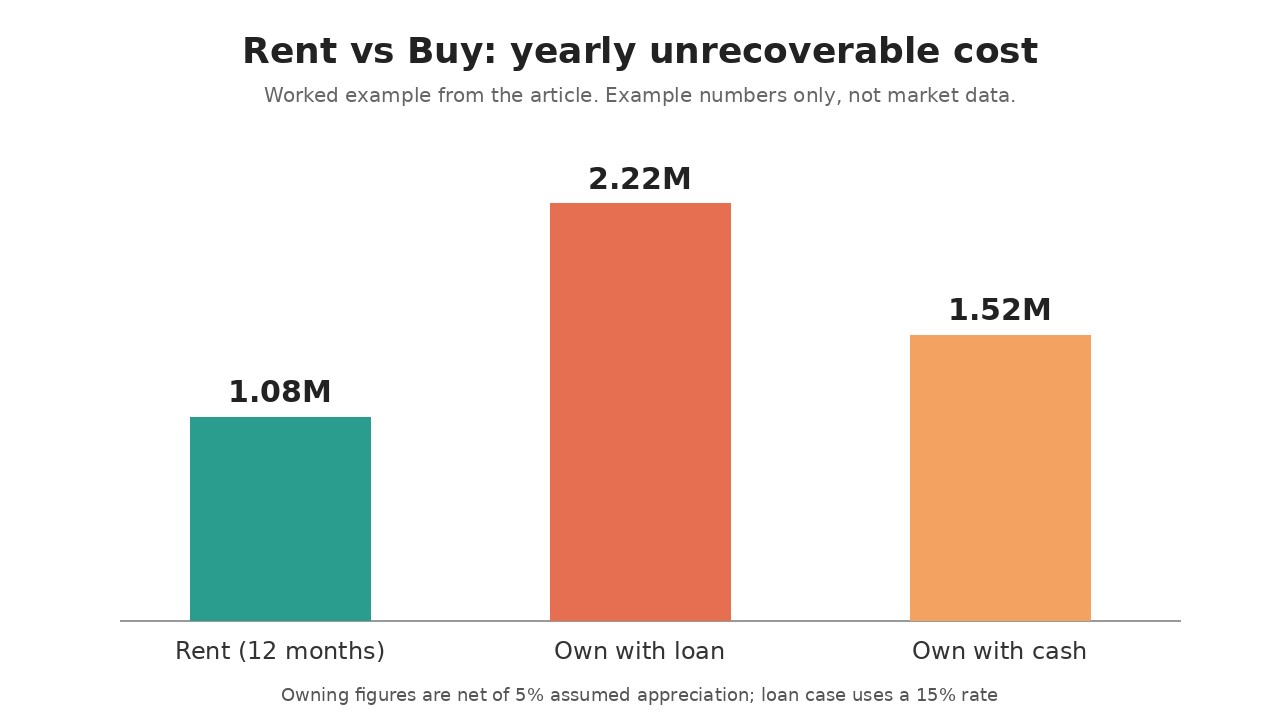
A worked example (illustrative numbers)
These figures are made up to show the method. Replace every one with real quotes before you decide anything.
Home price: 20,000,000
Down payment: 6,000,000, loan: 14,000,000 at 15 percent
Alternative return on the down payment: 10 percent after tax
Maintenance: 1 percent of value
Running charges: 120,000 per year
Buying plus selling costs: 1,200,000, planned stay: 6 years
Expected appreciation: 5 percent per year
Rent for a similar home: 90,000 per month
Yearly cost of owning, first year:
Interest: about 2,100,000
Opportunity cost: 600,000
Maintenance: 200,000
Running charges: 120,000
Transaction costs spread over 6 years: 200,000
Minus appreciation: -1,000,000
Net yearly cost of owning: about 2,220,000. Yearly rent: 1,080,000. In this example renting is cheaper by more than a million a year, mostly because of the high interest rate. Change the loan rate, the down payment or the appreciation and the answer can flip, which is the whole point: run your own numbers.
Now try the same example as a cash buyer with no loan. Interest drops to zero, but the opportunity cost rises to 2,000,000 because all 20,000,000 is tied up. The net cost becomes about 1,520,000, still above rent in this example. Cash buying is not automatically cheaper; it just moves the cost from the bank to your missed returns.
Step 4: Find your break-even stay
Because transaction costs shrink as you stay longer, there is usually a number of years after which buying starts to win. Recalculate the comparison for 3, 5, 8 and 12 years. If buying only wins after ten years and you are likely to move for work in four, renting is the safer choice. A spreadsheet with one row per year makes this quick, and it lets you test different interest and growth rates in seconds.
The questions numbers can't answer
When the math is close, these usually decide it:
How stable is your income and city? Owning suits people who are fairly sure where they will live and work for the next several years.
Do you have an emergency fund after the down payment? Emptying your savings to buy leaves you exposed to job loss or a big repair. Keep at least several months of expenses aside.
Can you live with less flexibility? Renting lets you move closer to a new job or school within weeks. Selling a home can take months.
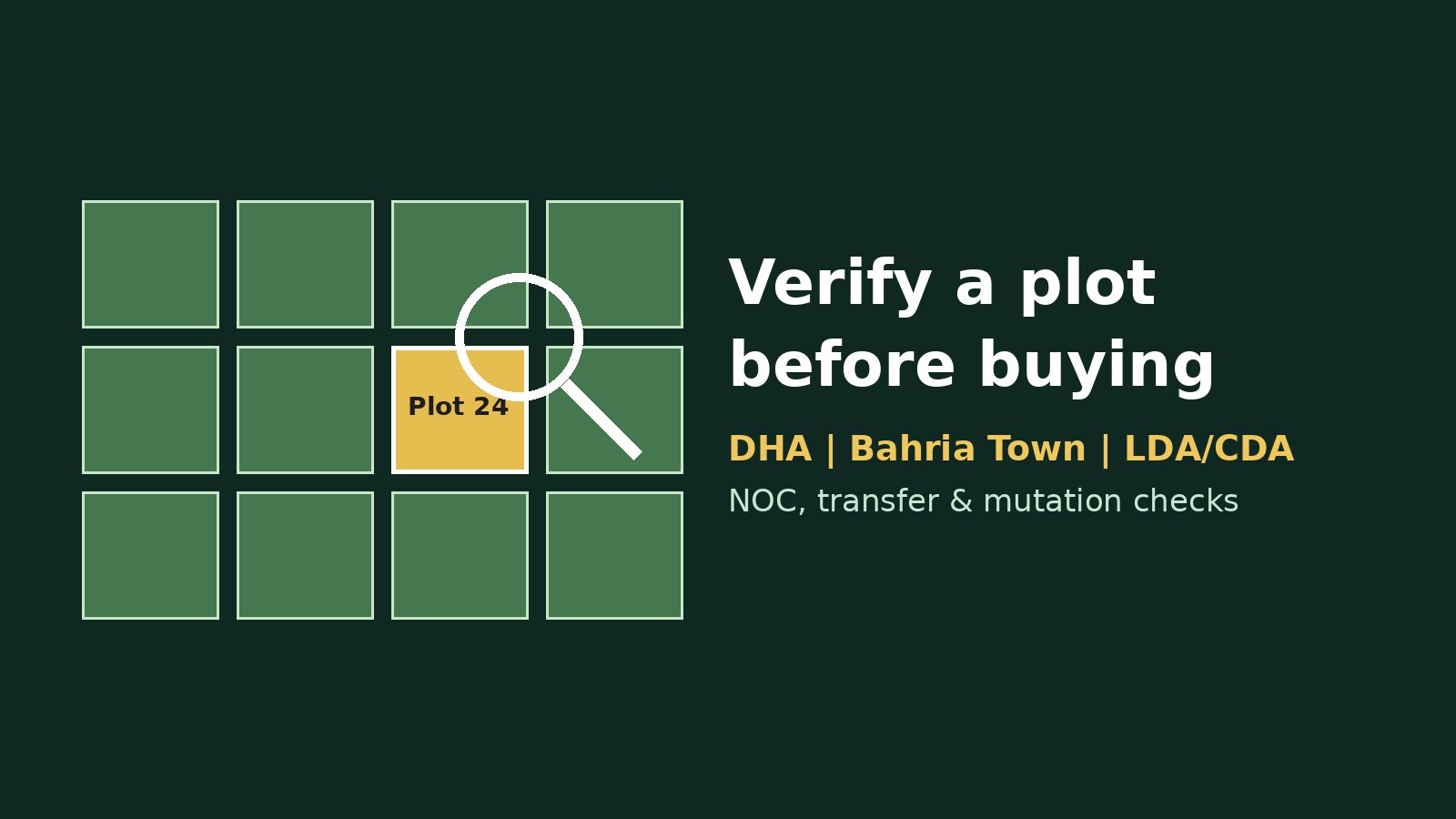
Is the title clean? A cheap price means nothing if the documents have problems. Before paying anything, follow a proper checklist like our guide on how to verify a plot in DHA or Bahria Town.
Is it a home or an investment? If you are really buying to rent out, use investor maths instead; see how to analyze a rental property before you buy.
Common mistakes to avoid
Comparing rent with the full monthly loan payment. Part of that payment is principal, which you keep. Compare unrecoverable costs only.
Ignoring the down payment's opportunity cost. Money in bricks is money not earning elsewhere.
Using peak-year price growth. Plan with a cautious rate and treat any extra as a bonus.
Forgetting exit costs. Selling has taxes and commission too.
Buying at the top of your budget. A home that stretches every rupee leaves nothing for repairs, schooling or emergencies.
Bottom line
Neither renting nor buying is automatically smarter. Add up the true yearly cost of owning, subtract a cautious estimate of appreciation, compare it with a year of rent, and check how long you need to stay for buying to win. If the numbers favour buying and your life is settled, buy with a healthy safety cushion. If they favour renting, rent without guilt and invest the difference consistently. Either way, you will be deciding with numbers instead of slogans.
Comments
Join the discussion. Replies load on demand, up to 5 levels.
0 threads
No comments yet
Be the first to start the conversation.