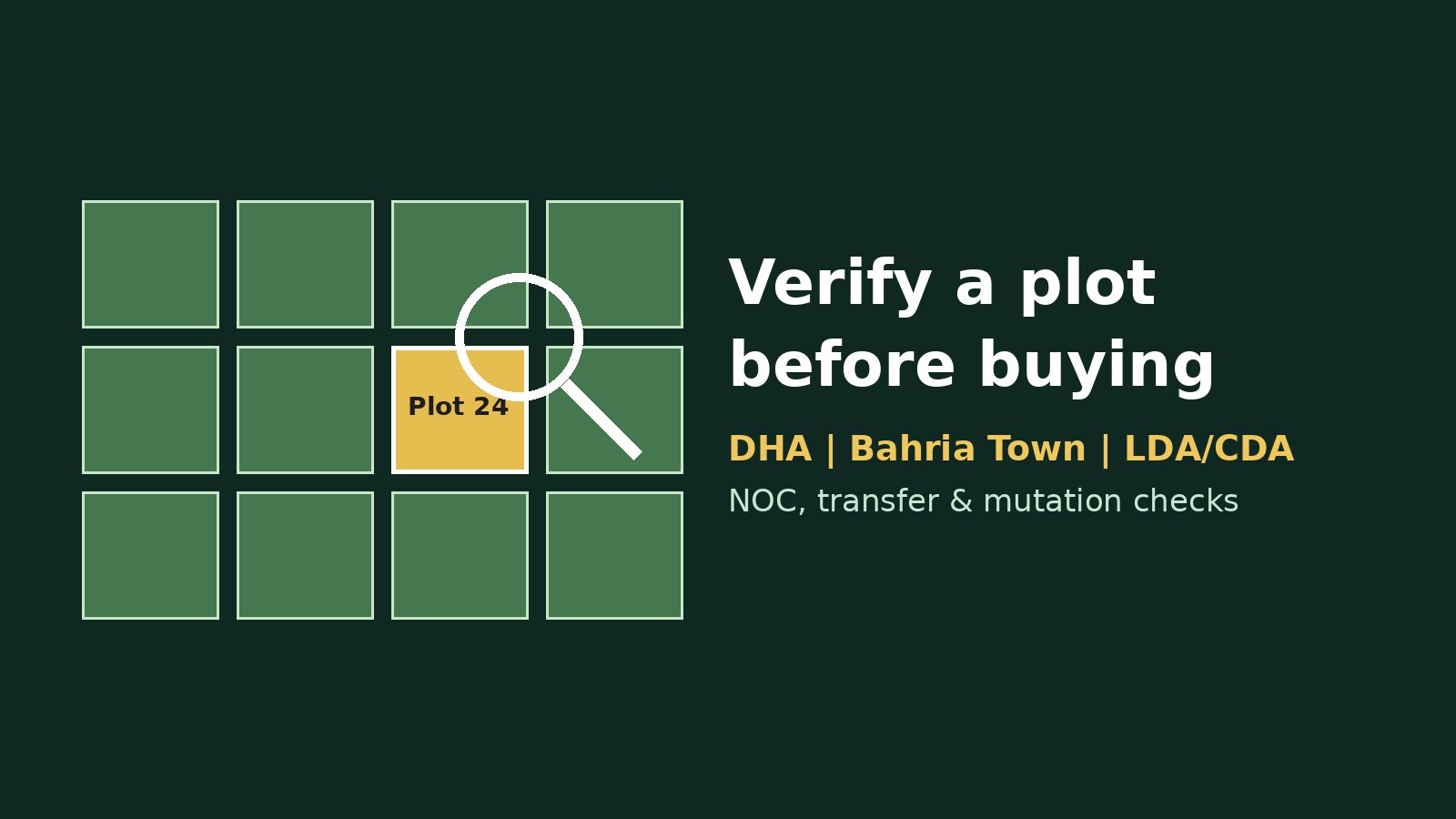
If you are planning to buy a plot in Pakistan, the most important step happens before any token money changes hands: you need to know how to verify a plot in DHA or Bahria Town before buying. Every year buyers lose savings to forged files, double-sold plots, fake "open forms", and societies without a valid NOC. The good news is that most of these scams fail a few simple checks. This guide walks through them step by step, for DHA, Bahria Town, and LDA- or CDA-regulated schemes.
Why Plot Verification Matters in Pakistan
Pakistan has two parallel property record systems. Land on the revenue record is tracked through the fard, intiqal (mutation), and registered sale deeds. Plots inside DHA, Bahria Town, and most private housing societies are tracked in the society's own register, with ownership shown by an allotment or transfer letter. Scammers exploit the gap: a buyer checks one system and assumes the other is fine. A genuine plot in an illegal society is still a bad buy, and a legal society can still contain a plot sold to two people.
How to Verify a Plot in DHA or Bahria Town: Step by Step
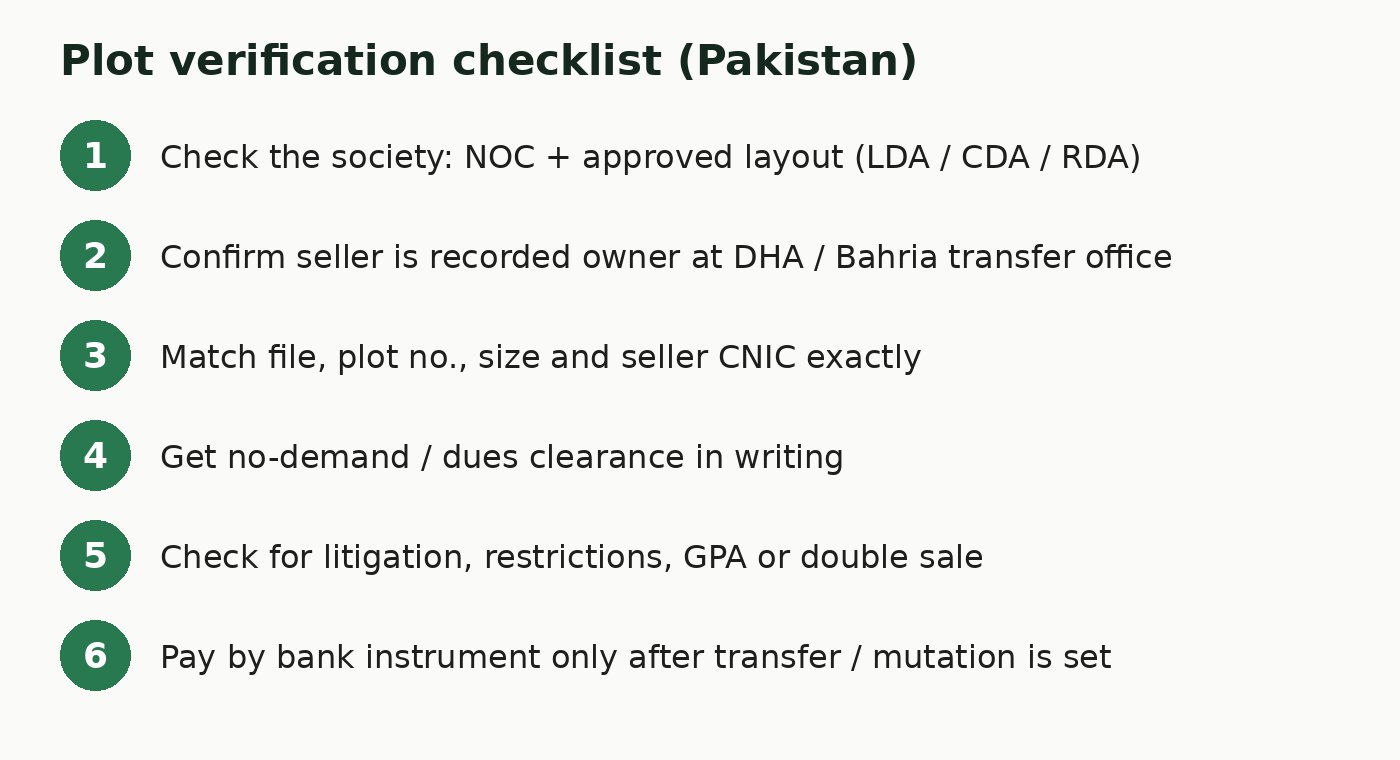
Step 1: Check the Society's NOC and Approved Layout
Start with the scheme itself. For private societies, check the relevant development authority's list of approved and illegal housing schemes: LDA in Lahore, CDA or RDA around Islamabad and Rawalpindi, SBCA in Sindh, and the matching authority elsewhere. Confirm the society has a valid NOC and an approved layout plan, and that your block or phase falls inside the approved area. DHA operates under its own law, and Bahria Town projects have their own approvals and history, so check the specific phase or precinct, not just the brand name. Remember: an NOC proves the scheme is approved; it says nothing about who owns your plot.
Step 2: Confirm the Seller Is the Recorded Owner
Visit the society's transfer or record office in person with the plot or file number. Ask three questions: Is this seller the recorded owner? Are there dues outstanding? Is the plot under any restriction, litigation, or cancellation? Many offices can issue an ownership confirmation or verification letter for a fee, and some offer official online or SMS verification. Use only official channels, never a screenshot or a "verification" link sent by the dealer.
Step 3: Match Every Detail Exactly
Compare the allotment or transfer letter with the society record: file number, plot number, street, block or sector, size, category (residential, commercial, corner, park-facing), and the owner's name, father's name, and CNIC. Forgers usually get one detail wrong. Check the seller's original CNIC against NADRA verification, and be extra careful when someone is selling on behalf of the owner under a general power of attorney (GPA). Confirm the GPA is genuine, registered, and still valid, or deal with the owner directly.
Step 4: Understand Files vs Allotted Plots
In DHA and Bahria Town, many deals are for files, not physical plots. A file is a right to a future plot, sometimes in a phase not yet developed or balloted. Ask whether the plot has been balloted, whether possession is available, and whether the site has been demarcated on the ground. Visit the plot with the society's map and confirm the number on site. Be cautious with heavily traded "open forms" and affidavit files, which carry higher risk.
Step 5: Clear Dues and Check for Disputes
Ask the society for a no-demand certificate covering development charges, installments, and membership fees. Check for court cases, family inheritance disputes, or a bank charge against the property. For land on the revenue record, get a fresh fard from the Arazi Record Centre or PLRA (in Punjab), trace the mutation history, and confirm no legal heirs were left out of past inheritance mutations.
Step 6: Transfer and Pay Safely
Pay only through traceable bank instruments such as a pay order, never large amounts of cash to a dealer. Keep the token or bayana amount small, and write a clear agreement that ties full payment to completed transfer at the society office or registered sale deed and mutation for revenue land. Both buyer and seller should usually attend the transfer in person, with biometric verification where required. Keep copies of every receipt and the new transfer letter.
Red Flags That Should Stop the Deal
- The price is far below other plots in the same block.
- The seller refuses to visit the transfer office or insists on cash.
- Documents are only photocopies, or details don't match the society record.
- The society appears on an authority's illegal schemes list.
- Pressure to pay today because "another buyer is waiting".
- The plot number can't be located on the ground or on the approved map.
If you are buying off-plan or into a new phase, also see our off-plan property due diligence checklist.
How Technology Is Helping Buyers
Digitization is slowly making verification easier. PLRA's land records portal and Arazi Record Centres have computerized much of Punjab's revenue record, and several societies now provide online ownership checks. Property portals are also starting to use AI to spot fake or duplicated listings, as we described in how AI can detect rental listing fraud. These tools help, but they don't replace an in-person check at the official office.
Before You Buy: Run the Numbers Too
Verification protects you from fraud; it doesn't tell you whether the plot is a good investment. Compare recent transfer prices, development status, and holding costs, and if you plan to build and rent, estimate yields the way we explain in how to analyze a rental property before you buy.
Quick Plot Verification Checklist
- Society or phase has a valid NOC and approved layout plan.
- Seller is the recorded owner at the official transfer office.
- File, plot, size, and CNIC details match exactly.
- Balloting, possession, and on-site location are confirmed.
- No dues, restrictions, litigation, or bank charges.
- Payment by bank instrument, tied to completed transfer or mutation.
Conclusion
Learning how to verify a plot in DHA or Bahria Town before buying takes a few hours and a couple of office visits, and it can save you years of legal trouble. Check the society, confirm ownership at the source, match every detail, clear dues, and pay safely. When in doubt, hire an independent property lawyer to review the file before you sign. Rules and procedures change, so always confirm the latest requirements with the relevant society or authority.