Typing a username and waiting on a full table lookup against tens of millions of rows does not feel "instant." A bloom filter username check answers the common case—definitely available—using a compact bit array and a handful of hashes, and only then asks PostgreSQL when the answer might be taken. Used correctly it is a powerful optimization. Used incorrectly it becomes a false sense of safety. This article explains the structure, RedisBloom usage, false positives, synchronization and why a unique index remains mandatory.
What the Structure Guarantees
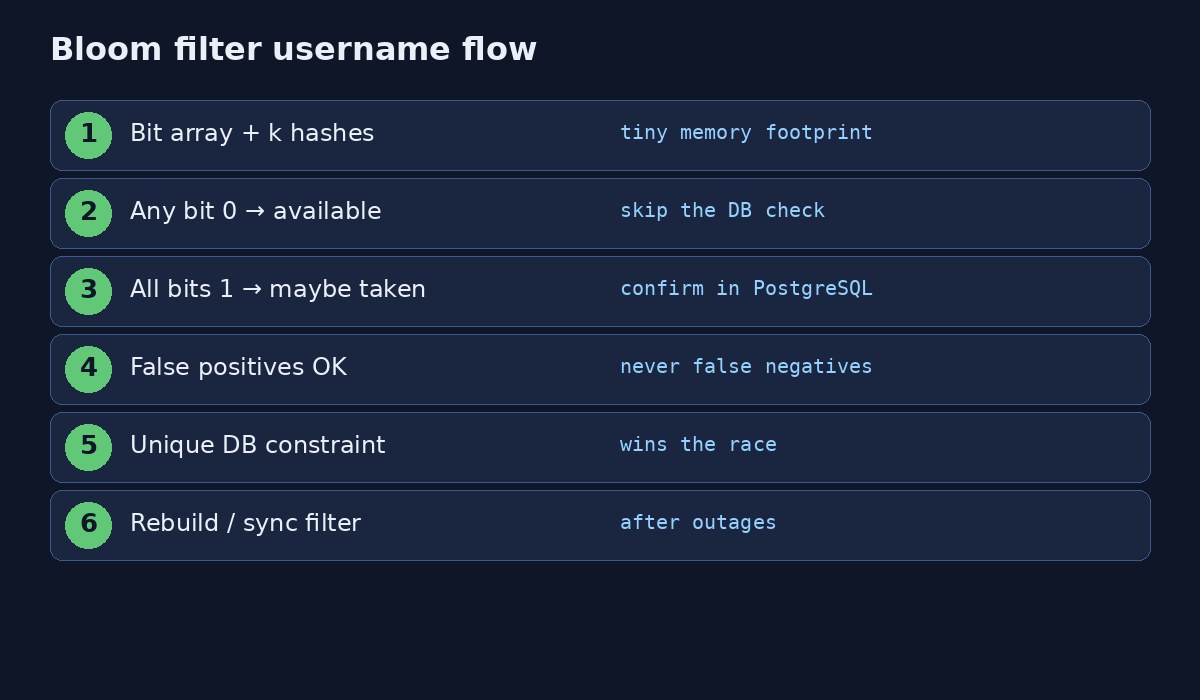
A Bloom filter is probabilistic membership storage. It never stores the raw username string. It stores bits flipped by hash functions. Results are asymmetric:
- Definitely not present when any required bit is zero—assuming the filter correctly represents the set.
- Possibly present when all required bits are one—false positives are expected and configurable.
A correctly maintained standard Bloom filter does not produce false negatives for items it has inserted. If the application says "available" because the filter is stale after a Redis outage, that is an operational sync bug, not the mathematical false-negative property.
Bit Arrays and Hash Functions
Start with a bit array of zeros. Inserting alice runs k independent hashes and sets those positions to one. Checking bob recomputes the same hashes. Any zero means skip the database existence query for the preliminary UX signal. All ones means confirm with SQL. Memory stays tiny compared with storing every string in a Redis SET, which is why Bloom filters appear in large-scale username, email and URL dedup paths.
RedisBloom Sketch
BF.RESERVE usernames 0.001 1000000
BF.ADD usernames alice
BF.EXISTS usernames john123
The reserve call targets roughly one million items at about a 0.1 percent false-positive rate. Tune both numbers to your cardinality and memory budget. Positive answers are invitations to query PostgreSQL, not final verdicts.
PostgreSQL as Source of Truth
CREATE UNIQUE INDEX users_username_unique ON users (username);Application flow: normalize the username, consult the Bloom filter, query on possibles, and on registration attempt an insert protected by the unique constraint. Two clients can still race; the constraint decides the winner. Connection pressure from chatty checks is a separate problem—see too many connections and PgBouncer.
Consistency and Deletion Limits
If PostgreSQL commits a username while Redis is down, the filter may later claim availability until rebuilt. Mitigations include change-data capture into the filter, periodic rebuilds, readiness flags that force DB checks when sync is uncertain, and treating filter outage as degrade-not-invent. Classic Bloom filters also struggle with deletes; counting Bloom filters or Cuckoo filters are alternatives when removals are frequent. Extra false positives after deletes usually only cost confirmation queries.
Other Production Uses
Beyond usernames: lead-phone prechecks in CRMs, "have we fetched this URL," CDN origin shields and large dedup pipelines—anywhere negatives dominate and memory is scarce. Always keep an authoritative store for the final write.
Caching layers elsewhere in the stack remain complementary; Bloom filters answer membership, not full record payloads. Pair with ordinary Redis value caches when you need the entity itself after the membership check—see Redis caching guidance.
FAQs
Can a Bloom filter guarantee a username is free?
It can guarantee absence from the set it currently represents when a bit is zero. Final registration still requires a unique database write.
Why accept false positives?
They trade occasional extra SQL confirmations for massive memory savings versus exact sets.
Bloom filter versus a Redis SET?
SETs are exact and heavier. Bloom filters excel at huge sets where cheap negatives matter most.
Operational Checklist Teams Actually Use
Write the runbook while the system is healthy. Name the dashboards that show latency, error rate, saturation and dependency health. Record which alerts page which engineers, and which feature flags disable expensive paths when a dependency falters. After every incident, add one concrete prevention item—an index, a probe, a lock, a backoff—and assign an owner with a date.
Load-test the golden journeys before campaigns: authentication, search, write paths and payment or booking confirmation. Synthetic traffic that only hits health endpoints will not reveal stampede, lock or migration bugs. Prefer realistic payloads and concurrency patterns captured from production anonymized traces.
Keep environment parity honest. Staging should exercise the same session store, cache backend, queue driver and migration path as production, even at smaller scale. Many "works on my machine" deploy failures are really "staging used the file session driver." Align configuration templates and fail CI when critical env keys diverge.
Security and reliability meet in the same releases. Rotate credentials when workers or containers may have logged them, limit debug endpoints and ensure readiness checks never expose secrets. Customer-facing promises—fast pages, safe checkout, always-on apps—depend on these unglamorous controls as much as on clever algorithms.
How This Fits Customer-Facing Messaging
Engineering topics translate cleanly into buyer language when you stay specific. Faster page loads come from caching and query work. Fewer failed checkouts come from idempotent retries and primary reads after writes. Continuous releases without maintenance banners come from zero-downtime deployment discipline. Instant "username taken" feedback comes from probabilistic filters backed by real constraints. Use those outcomes in titles and meta descriptions so searchers who care about reliability find the technical depth behind the promise.
Comments
Join the discussion. Replies load on demand, up to 5 levels.
0 threads
No comments yet
Be the first to start the conversation.