A payment provider times out. Thousands of clients retry immediately. The provider, already sick, receives a second wave and stays sick longer. That amplification is a retry storm. Exponential backoff slows retries with growing delays; jitter desynchronizes clients; idempotency prevents double charges; circuit breakers stop pointless traffic when the dependency is dark.
Why Immediate Retries Are Dangerous
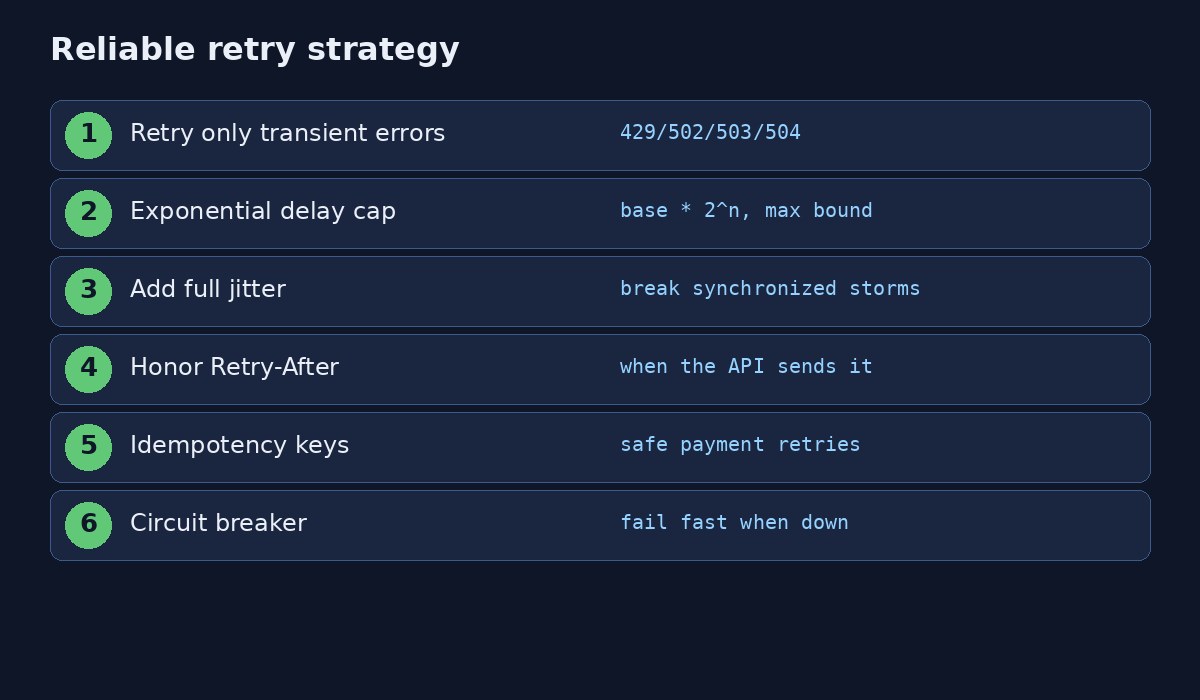
Retries help only when failures are transient and limited. Without control, every layer—browser, API gateway, HTTP client, queue worker—may multiply the same logical call. Edge symptoms often look like 502 or 504 while the deeper issue is synchronized client behavior.
The Core Formula
delay = min(max_delay, base_delay * (2 ** attempt))
# base 100ms, max 2000ms → 100, 200, 400, 800, 1600, 2000
Caps prevent absurd waits. The idea is simple: each failure buys the dependency more recovery time.
Full Jitter
delay = random.uniform(0, min(max_delay, base_delay * (2 ** attempt)))Identical exponential schedules recreate herd behavior at each step. Full jitter spreads attempts across the window and is widely recommended for client libraries.
Retry Only Transient Failures
- Often retryable: 429, 502, 503, 504, selected connection resets.
- Usually not: 400, 401, 403, validation errors.
- On 429, prefer the server's
Retry-Afterwhen present.
Idempotency for Side Effects
Timeouts are ambiguous—the charge may have succeeded. Send Idempotency-Key: payment-installment-1001 so providers deduplicate. Backoff times the attempt; idempotency protects money and inventory. If the provider lacks keys, reconcile status before creating a new payment intent.
Laravel Patterns
public function backoff(): array
{
    return [10, 30, 90]; // seconds
}
Job backoff arrays are progressive schedules. HTTP clients should declare max attempts, retryable statuses, deadlines and idempotency. Prefer one primary retry layer so workers and gateways do not multiply each other. More queue context: Laravel queue Redis.
Circuit Breakers
Closed allows traffic; open fails fast after repeated errors; half-open probes recovery. Combine with timeouts and a global retry budget. Breakers protect your process and the dependency.
Webhook Example
Receive and acknowledge a lead webhook quickly, enqueue fetch work, retry transient Meta API failures with backoff and jitter, and dedupe by event id so at-least-once delivery does not create duplicate CRM rows.
FAQs
Why exponential backoff with jitter?
Growing delays give room to recover; jitter prevents synchronized retry spikes.
Retry every HTTP 500?
Only when safe and likely transient. Prefer provider semantics and idempotent operations.
Where should retries live?
Choose one main layer. Nested retries multiply load during outages.
Operational Checklist Teams Actually Use
Write the runbook while the system is healthy. Name the dashboards that show latency, error rate, saturation and dependency health. Record which alerts page which engineers, and which feature flags disable expensive paths when a dependency falters. After every incident, add one concrete prevention item—an index, a probe, a lock, a backoff—and assign an owner with a date.
Load-test the golden journeys before campaigns: authentication, search, write paths and payment or booking confirmation. Synthetic traffic that only hits health endpoints will not reveal stampede, lock or migration bugs. Prefer realistic payloads and concurrency patterns captured from production anonymized traces.
Keep environment parity honest. Staging should exercise the same session store, cache backend, queue driver and migration path as production, even at smaller scale. Many "works on my machine" deploy failures are really "staging used the file session driver." Align configuration templates and fail CI when critical env keys diverge.
Security and reliability meet in the same releases. Rotate credentials when workers or containers may have logged them, limit debug endpoints and ensure readiness checks never expose secrets. Customer-facing promises—fast pages, safe checkout, always-on apps—depend on these unglamorous controls as much as on clever algorithms.
How This Fits Customer-Facing Messaging
Engineering topics translate cleanly into buyer language when you stay specific. Faster page loads come from caching and query work. Fewer failed checkouts come from idempotent retries and primary reads after writes. Continuous releases without maintenance banners come from zero-downtime deployment discipline. Instant "username taken" feedback comes from probabilistic filters backed by real constraints. Use those outcomes in titles and meta descriptions so searchers who care about reliability find the technical depth behind the promise.
Comments
Join the discussion. Replies load on demand, up to 5 levels.
0 threads
No comments yet
Be the first to start the conversation.