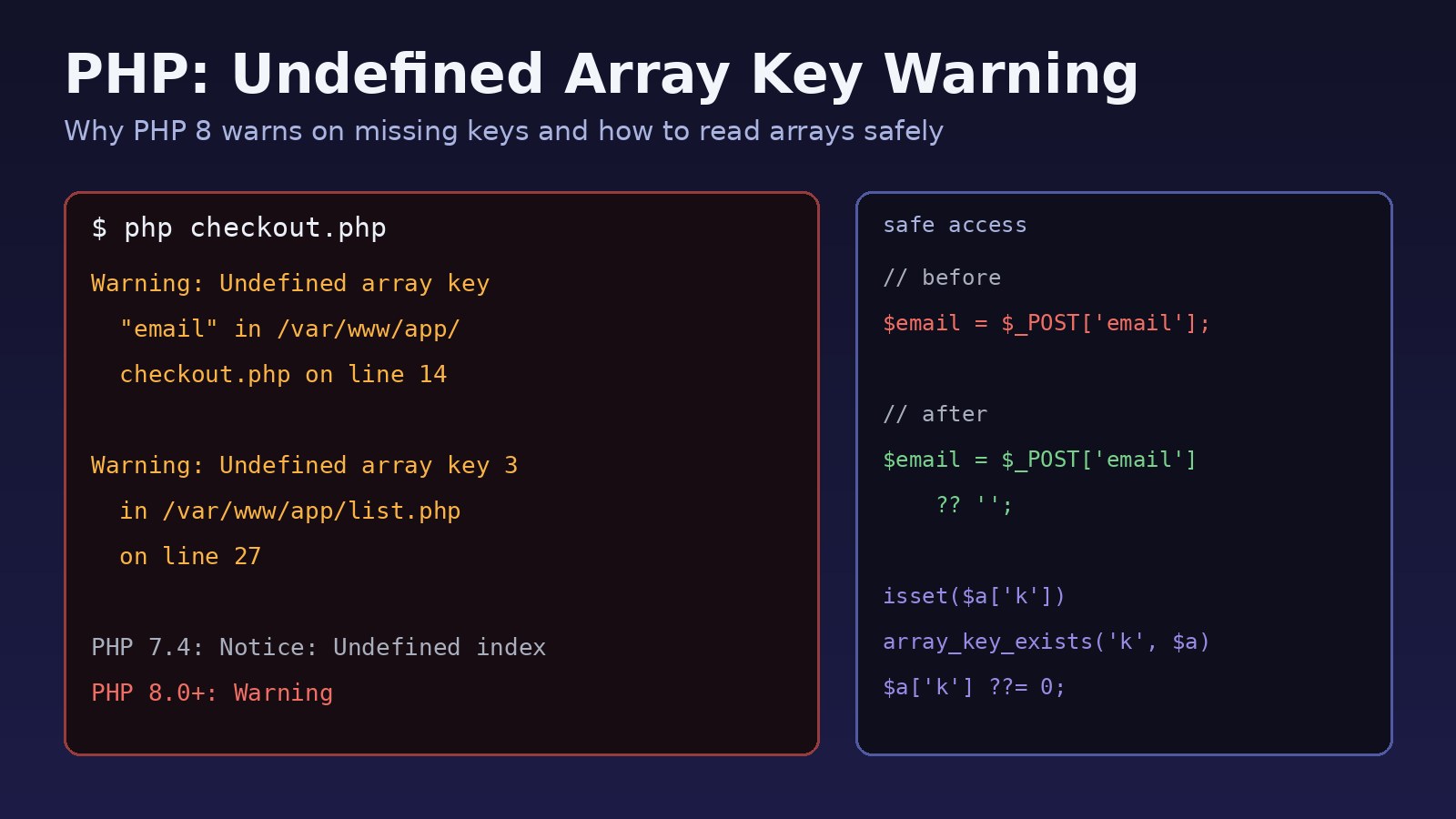
Your page still loads, but the log fills with Warning: Undefined array key "email", or a Laravel app throws an ErrorException and returns a 500. The php undefined array key warning means your code read an array element that doesn't exist. PHP 8 made this louder than older versions, so code that ran quietly on PHP 7.4 often starts warning after an upgrade. This guide shows why it happens, how to fix it properly with ??, isset() and array_key_exists(), and how to stop new cases reaching production.
Problem: PHP Undefined Array Key After Upgrading to PHP 8
In PHP, reading $array['key'] when 'key' isn't set doesn't stop the script. PHP returns null and raises a diagnostic. In PHP 7.4 that was a notice (Undefined index for string keys, Undefined offset for integer keys), which many servers hid. PHP 8.0 renamed both to Undefined array key and raised the level to E_WARNING, so they show up in logs, error trackers and framework error pages.
The real problem isn't the message. It's that your code assumed data would be there: a form field, a query parameter, a JSON property, a config value or a row column. When the assumption is wrong you get null, and that null can quietly flow into a database insert, a price calculation or an ERP sync job.
Symptoms: PHP Warning and Array Key Not Found Messages
Depending on the key type and PHP version, you'll see one of these:
# PHP 8.x
Warning: Undefined array key "email" in /var/www/app/checkout.php on line 14
Warning: Undefined array key 3 in /var/www/app/list.php on line 27
Warning: Trying to access array offset on value of type null in /var/www/app/report.php on line 41

# PHP 7.4 and older
Notice: Undefined index: email in /var/www/app/checkout.php on line 14
Notice: Undefined offset: 3 in /var/www/app/list.php on line 27
Other signs:
- Laravel shows
ErrorException: Undefined array key "phone", because its error handler converts PHP warnings into exceptions. - An API returns HTTP 500 for some requests only, usually when an optional field is missing from the payload.
- Warning text is printed into the HTML or JSON output when
display_errorsis on, which breaks JSON parsing in a React or Next.js frontend. list()or[$a, $b] = explode(',', $value)warns withUndefined array key 1when the string has no comma.
Root Cause: Why PHP Can't Find the Array Key
Optional input treated as required
$_POST, $_GET and decoded JSON only contain what the client sent. An unchecked checkbox, a missing query string or an older mobile app version leaves the key out entirely.
Wrong key name or case
Array keys are case-sensitive. $row['Email'] and $row['email'] are different keys, and a database driver or API may return names in a different case or format than you expect, for example created_at instead of createdAt.
Index out of range
Loops that use $i <= count($items), code that reads $items[0] from an empty result, and arrays whose indexes were changed by unset() or array_filter() all read integer keys that don't exist.
Nested data that's only sometimes there
$order['customer']['address']['city'] fails at the first missing level. If customer is missing you get an undefined array key warning, followed by Trying to access array offset on value of type null for the next level.
Step-by-Step Solution
Step 1: Find the exact line and the real data
The warning gives you the file and line. Before changing code, dump what the array actually contains at that point:
// temporary debugging only
error_log(print_r(array_keys($_POST), true));
var_dump($payload);

// Laravel
logger()->debug('payload', $request->all());
Then decide: is the key genuinely optional, or is its absence a bug? Optional keys need a default. Required keys need validation that rejects the request early with a clear error.
Step 2: Use the null coalescing operator for defaults
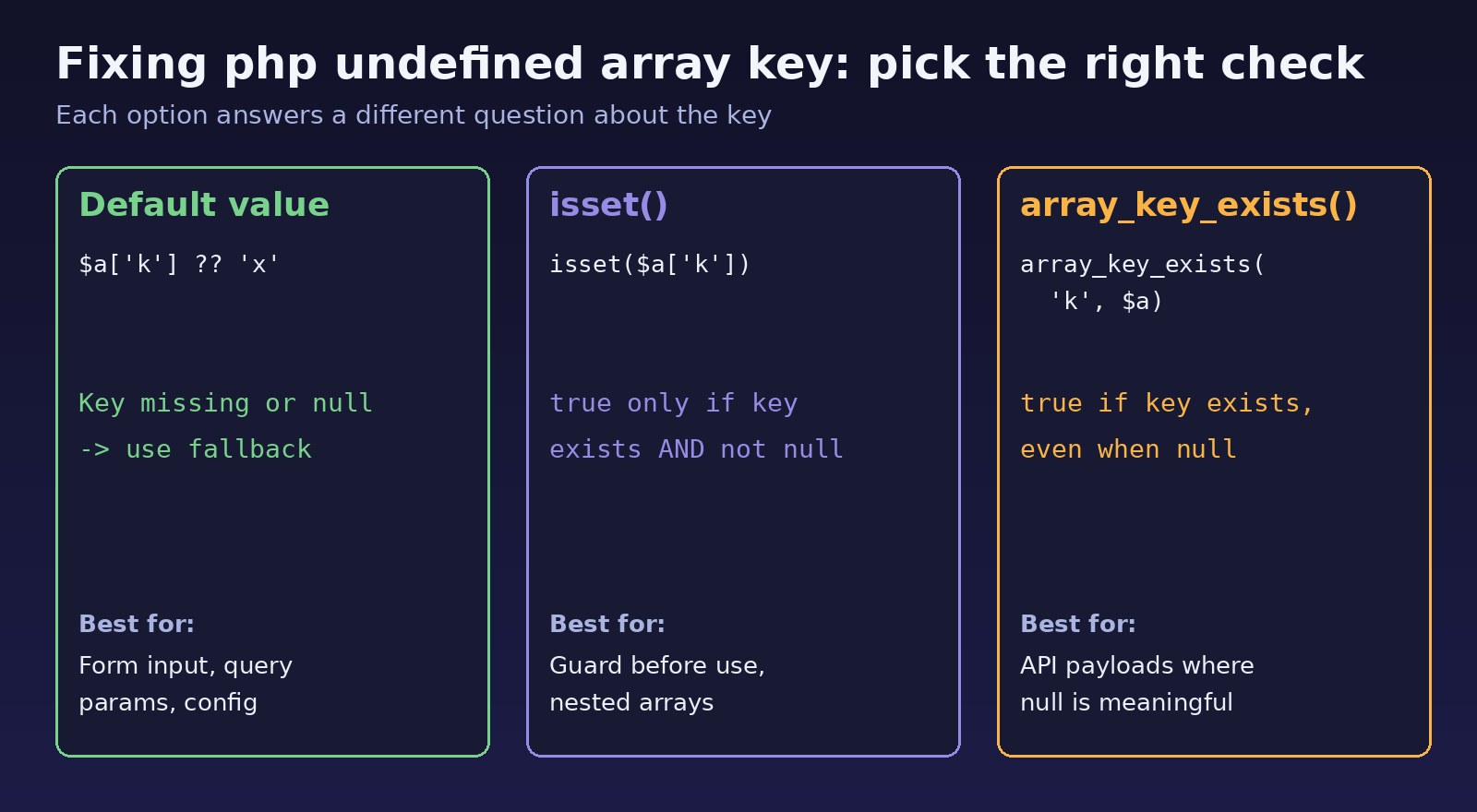
The ?? operator (PHP 7.0+) returns the left side if it exists and isn't null, otherwise the right side. It never raises a warning, even for nested keys:
// before: warns when the field is missing
$email = $_POST['email'];
$page  = $_GET['page'];

// after
$email = $_POST['email'] ?? '';
$page  = (int) ($_GET['page'] ?? 1);
$city  = $order['customer']['address']['city'] ?? 'Unknown';

// assign a default only if missing (PHP 7.4+)
$options['timeout'] ??= 30;
Step 3: Use isset() or array_key_exists() for checks
When you need to branch rather than default, check first. The difference matters when the value can be null:
$data = ['discount' => null];

isset($data['discount']);            // false: key exists but value is null
array_key_exists('discount', $data); // true: key exists

if (isset($data['coupon'])) {
    applyCoupon($data['coupon']);
}

// null means "clear the field" in this API, so check the key itself
if (array_key_exists('discount', $data)) {
    $product->discount = $data['discount'];
}
Use isset() for most guards. Use array_key_exists() for PATCH-style API payloads where sending null is different from not sending the field at all.
Step 4: Fix integer index and destructuring bugs
For numeric arrays, fix the logic rather than hiding the warning:
// off-by-one: <= reads one past the end
for ($i = 0; $i < count($items); $i++) { /* ... */ }
foreach ($items as $item) { /* better */ }

// first/last element of a possibly empty array
$first = $items[0] ?? null;
$firstKey = array_key_first($items);   // PHP 7.3+, null if empty

// reindex after array_filter() or unset()
$items = array_values(array_filter($items));

// explode() with a limit and padding
[$user, $domain] = array_pad(explode('@', $email, 2), 2, null);
Step 5: Laravel and framework helpers
In Laravel, read request data through the request object instead of raw arrays. These helpers return a default instead of raising an exception:
use Illuminate\Support\Arr;

$email = $request->input('email', '');
$city  = $request->input('customer.address.city');   // dot notation
$phone = Arr::get($payload, 'contact.phone', null);
$sku   = data_get($order, 'items.0.sku');

// validated() only contains keys that passed validation
$data = $request->validate([
    'name'  => 'required|string',
    'phone' => 'nullable|string',
]);
$phone = $data['phone'] ?? null;   // may be absent if not sent
Note that $data['phone'] can still throw if the client didn't send phone, because nullable allows a missing field. Keep the ?? or add the present rule if the field must always be sent. If the error comes from a misconfigured class binding rather than data, see how to fix Laravel Target Class Does Not Exist.
Step 6: Don't silence the warning
Avoid the @ operator (@$arr['key']) and avoid lowering error_reporting to drop E_WARNING. Both hide the symptom and leave the missing-data bug in place, and @ also hides other warnings on the same line.
Code/Commands: Finding Every Undefined Array Key
Search the code base for direct superglobal access, which is the most common source after a PHP 8 upgrade:
grep -rnE "\$_(GET|POST|REQUEST|COOKIE|SERVER)\[" app/ src/ public/ --include=*.php

# count recent warnings in the PHP or Laravel log
php -i | grep -E "^error_log"
grep -c "Undefined array key" storage/logs/laravel.log

# static analysis catches many cases before runtime
composer require --dev phpstan/phpstan
vendor/bin/phpstan analyse src --level=6
In Docker, check the container logs too: docker compose logs php --since 1h | grep "Undefined array key". If warnings are printed before headers, you may also see Cannot modify header information - headers already sent, and behind Nginx a fatal error can turn into a gateway error; see 502 Bad Gateway in Nginx if that's what users see.
Verification
Turn on full reporting in development so nothing is hidden, then repeat the request that failed, including the missing-field case:
; php.ini (development)
error_reporting = E_ALL
display_errors = On
log_errors = Onphp -l app/Http/Controllers/CheckoutController.php
curl -s -X POST https://localhost/api/checkout -H "Content-Type: application/json" -d '{}'
tail -n 50 storage/logs/laravel.log | grep -i "undefined array key" || echo "clean"The fix is verified when the request returns the expected response (a default value or a clear 422 validation error), the log stays clean, and your PHPUnit or Pest tests cover both the "key present" and "key missing" cases. If a React frontend calls this endpoint, confirm it receives valid JSON; stray warning text in the body is a common cause of failed requests that look like the problems in CORS error in React and Laravel.
Prevention
- Validate every request at the boundary (Laravel Form Requests or a schema validator) and only read validated data afterwards.
- Use
??for every truly optional value, and give it a meaningful default. - Prefer typed DTOs or value objects over passing raw associative arrays through many layers.
- Run PHPStan or Psalm in CI and add array shape annotations such as
@param array{email: string, phone?: string} $data. - Keep
error_reporting = E_ALLin development and staging so warnings appear before production. - Write tests with incomplete payloads, empty arrays and empty strings, not only the happy path.
- Before a PHP version upgrade, run the test suite and static analysis on the new version in a Docker image first.
FAQs
What does "Undefined array key" mean in PHP?
Your code read an array element using a key that isn't in the array. PHP returns null for that read and raises a warning so you know the data wasn't what you expected.
Is the PHP warning for an undefined array key an error?
In plain PHP it's an E_WARNING, so the script keeps running. Frameworks like Laravel convert it into an ErrorException, so in practice it can stop the request and return a 500.
What is the difference between Undefined index and Undefined array key?
They describe the same problem. PHP 7.4 and older used Undefined index for string keys and Undefined offset for integer keys as notices. PHP 8.0 merged them into Undefined array key as a warning.
How do I fix array key not found without changing every line?
Start with the places where external data enters: request input, JSON decoding and database rows. Validate there and fill defaults, so the rest of the code can trust the array. Use the grep and PHPStan commands above to list the remaining direct reads.
Should I use isset() or array_key_exists()?
Use isset() when null should count as "not set", which covers most cases. Use array_key_exists() when a key with a null value has a different meaning from a missing key.
Is it safe to hide the warning with @ or error_reporting?
No. It hides the message but not the bug, and the code still continues with null. Fix the read with a default, a check or validation instead.
Comments
Join the discussion. Replies load on demand, up to 5 levels.
0 threads
No comments yet
Be the first to start the conversation.